
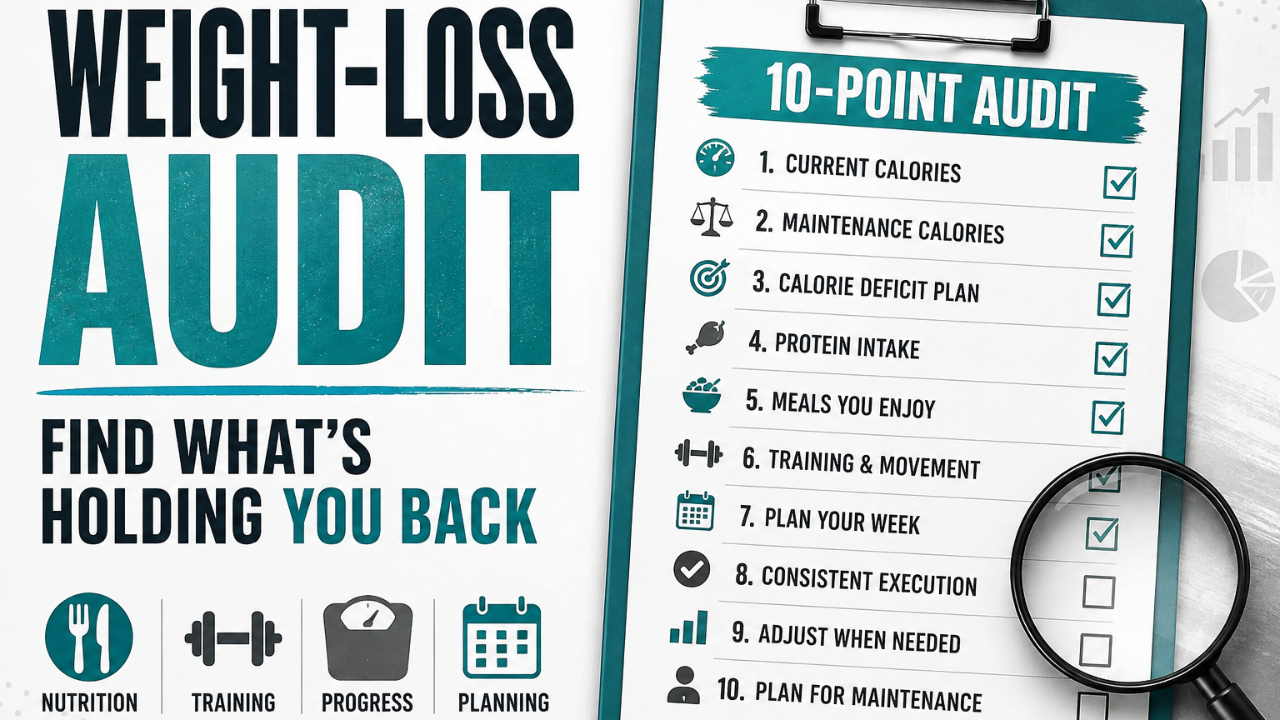
Free Weight-Loss Audit: Find What’s Holding You Back
Aug 09, 2026The Weight-Loss Audit
If you are struggling to lose weight or keep it off, something in your process is missing.
This 10-question audit will help you identify exactly where the gap is. Answer based on what you know and consistently do right now, not what you plan to do.
Every question you cannot confidently answer YES to points to something that needs to be fixed.
1. Do you know how many calories you are currently eating?
Not simply: “I eat pretty healthy,” “I don’t eat that much,” or “I watch what I eat.”
Can you actually estimate how many calories you consume on a normal day and across a normal week?
Why it matters: You cannot intelligently reduce your calorie intake if you do not know where you are starting. If you are currently eating 2,400 calories, the right starting deficit will look very different than it would for someone eating 1,700.
Without knowing your current intake, people often make one of two mistakes: they reduce too little and never create a meaningful deficit, or they reduce far more than necessary and make the diet harder than it needs to be.
It also makes troubleshooting nearly impossible. If your weight is not changing, you need to be able to compare what you are actually eating with what your body is actually doing.
Why it matters later: Maintenance requires the same awareness. If you never understand how much food you are consuming, it becomes difficult to recognize when your normal intake has gradually moved above what your body needs.
2. Do you know approximately how many calories maintain your current weight?
Not simply: “My app gave me a number,” “I have a slow metabolism,” or “I know I need to eat less.”
Do you have a realistic maintenance estimate supported by your current intake and what your weight has actually been doing?
Why it matters: A calorie deficit is not a random number. It exists only in relation to the amount of energy your body needs to maintain its current weight.
If your maintenance is approximately 2,200 calories, then 1,800 creates a very different deficit than 1,200. Without knowing maintenance, there is no way to judge whether your calorie target is appropriate, unnecessarily aggressive, or not a deficit at all.
This is why blindly copying someone else’s calories, choosing the lowest number an app gives you, or assuming less is always better creates problems.
Why it matters later: Maintenance is where the diet eventually needs to lead. If you understand only how to reduce calories but never learn what maintenance looks like, you are left believing that the only way to control your weight is to remain on a diet.
The goal is not to eat less forever.
3. Do you know exactly how you are going to create your calorie deficit?
Not simply: “I’m going to eat healthier,” “I’m cutting carbs,” “I’ll stop eating after 7,” or “I’m just going to eat less.”
What is your calorie target? What are you changing from the way you currently eat? What meals are you going to eat?
Why it matters: “Eating healthier” does not automatically create a calorie deficit. You can eat nutritious foods and still consume more calories than your body needs.
A real weight-loss plan defines how much you are eating and how you are going to consistently achieve it. That may mean changing portions, adjusting meals, reducing certain calorie-dense foods, limiting restaurant meals, or restructuring your normal eating.
Without that clarity, each day becomes a new experiment. You eat less when you remember, tighten things up after the scale increases, loosen up when you get tired of dieting, and never create enough consistency to accurately judge the result.
Why it matters later: The method you use to lose weight teaches you habits. If your method is built entirely around extreme restriction, eliminating foods you enjoy, or rules you cannot maintain, then the habits you practiced during weight loss disappear as soon as the diet ends.
4. Do you know how much protein you need and how you will consistently reach it?
Not simply: “I eat chicken,” “I drink a protein shake,” or “I try to have protein with my meals.”
Do you know your daily protein target, and can you consistently build your meals around reaching it?
Why it matters: Losing weight means your body is operating with less incoming energy. During that process, the goal is to encourage your body to lose fat while preserving as much lean mass as possible.
Adequate protein, combined with strength training, helps protect muscle during a calorie deficit. Protein also requires more energy to digest than carbohydrate or fat and can help meals feel more satisfying.
If protein intake is consistently too low, you can still lose weight, but you increase the risk of losing more lean mass along with the fat.
The goal is not simply to weigh less. The goal is to create a stronger, healthier body at a lower body-fat level.
Why it matters later: Muscle remains valuable after the diet ends. Protein continues supporting recovery, strength, body composition, and the training necessary to maintain the body you built.
5. Do you have meals you enjoy that fit your calorie and protein targets?
Not simply: “I’ll eat salads,” “I’m meal prepping chicken and broccoli,” or “I know which foods are healthy.”
Do you have actual breakfasts, lunches, dinners, and snacks you enjoy, that fit your targets and your real life?
Why it matters: A calorie target is only useful if you can translate it into meals.
If your target is 1,700 calories but you have no idea what 1,700 calories looks like across breakfast, lunch, dinner, snacks, and the foods you actually enjoy, then the number does very little for you.
This is where people end up making decisions meal by meal, underestimating portions, grabbing whatever is convenient, skipping meals and overeating later, or repeatedly ordering food because nothing was planned.
A reliable collection of meals removes that uncertainty. You already know what fits. You already know what you enjoy. You already know what to buy.
Why it matters later: The best meals for maintenance are not completely different from the meals you ate while losing weight. Your foundation can remain the same while portions, flexibility, restaurant meals, and other foods become easier to accommodate.
That creates continuity instead of finishing one way of eating and having to invent another.
6. Do you have a consistent strength-training and movement routine?
Not simply: “I work out when I can,” “I’m pretty active,” or “I walk sometimes.”
Do you know which days you train, what workouts you are completing, and what your normal daily movement looks like?
Why it matters: Weight loss and fitness are not the same thing. A calorie deficit can make the scale go down, but it does not automatically build strength, preserve muscle, improve cardiovascular fitness, increase mobility, or create the physical capacity you want.
Strength training gives your body a reason to retain muscle while dieting. Daily movement also contributes to energy expenditure and prevents your activity level from quietly declining as calories are reduced.
Without a defined routine, activity becomes dependent on mood, motivation, free time, or whether the week happens to cooperate.
Why it matters later: When weight loss ends, training and movement do not. They are part of the lifestyle that keeps you strong, capable, active, and healthy.
You are not exercising only to burn calories.
You are establishing how you intend to live.
7. Do you plan your nutrition, training, and movement before the week happens?
Not simply: “I know what I’m supposed to do,” “I’ll figure it out tomorrow,” or “I’ll work out when I have time.”
Do you know when you are grocery shopping, what food needs to be in the house, what you are eating, when you are training, and when your movement will happen?
Why it matters: Every decision you leave until the moment it needs to be made creates another opportunity for convenience, emotion, fatigue, time pressure, or hunger to make the decision for you.
If dinner is not planned, takeout becomes easier. If groceries are not in the house, the plan cannot be followed. If workouts are not placed into the week, other responsibilities will naturally fill the available time.
Planning turns good intentions into scheduled actions.
It also reduces the number of decisions you have to make every day. Instead of repeatedly asking “What should I eat? When am I working out? Do I have time to walk?” the answer has already been decided.
Why it matters later: Your life will never become permanently quiet and convenient. Work, family, travel, weekends, holidays, appointments, and unexpected problems will continue.
Maintenance requires a system that can function inside real life, not only when life is easy.
8. Are you following your plan consistently enough to know whether it works?
Not simply: “I’m good during the week,” “I eat well most of the time,” or “I’ve been trying really hard.”
Are you actually following your nutrition, training, and movement plan closely enough to accurately judge the results?
Why it matters: A plan cannot be evaluated if it is not being followed.
You may have a perfectly appropriate calorie target, but if extra calories repeatedly enter through restaurant meals, alcohol, snacks, drinks, larger portions, or weekends, your actual intake may be very different from the plan on paper.
Then people often respond by cutting calories even lower Monday through Friday, which makes the diet harder while failing to address the real problem.
Before adjusting anything, you need to know:
Did the plan fail, or did the execution fail?
If the plan was not followed, changing the plan does not solve the problem.
Why it matters later: Maintaining weight also depends on repeatable behavior. You do not need perfection, but your normal routine needs to consistently support the outcome you want.
The more consistent your habits become, the less often you need to “start over.”
9. Do you know when and how to adjust your plan when weight loss slows?
Not simply: “I’ll eat even less,” “I’ll do more cardio,” or “The scale didn’t move this week, so I need to change something.”
Do you know how long to evaluate progress, what data to use, when an adjustment is actually necessary, and what to adjust?
Why it matters: Body weight fluctuates for reasons that have nothing to do with fat gain or fat loss. Water retention, sodium, carbohydrate intake, digestion, menstrual cycles, stress, and other factors can temporarily move the scale.
If you react to every fluctuation, you can continually cut calories or increase exercise when nothing was actually wrong.
At the same time, a deficit that worked earlier may eventually need to be adjusted as body weight decreases.
The skill is knowing when progress has actually stalled and making the smallest adjustment necessary to restart it.
That protects you from turning every plateau into a punishment.
Why it matters later: Maintenance requires the ability to distinguish between a normal fluctuation and an actual trend.
If every two-pound increase triggers panic, restriction, and another diet, you never truly learn how to maintain your weight.
10. Do you know what you are going to do when the diet ends?
Not simply: “I’ll keep eating healthy,” “I’ll be careful,” or “Once I lose the weight, I’ll figure it out.”
Do you know how you will transition out of the deficit, establish maintenance, continue training and movement, add more flexibility to your nutrition, manage restaurants and alcohol, and respond to normal changes in your weight?
This may be the most important question on the audit.
Why it matters: Most weight-loss methods are designed around one objective: getting the weight off.
But reaching your goal weight does not automatically teach you what to do next.
If your entire strategy has been eating as little as possible, avoiding restaurants, eliminating certain foods, doing large amounts of cardio, or following rigid diet rules, eventually you are going to want more flexibility.
If there is no plan for that transition, people often go directly from dieting back to the way they were living before the diet.
That is where regain begins.
The goal is not to eat less forever. That is not sustainable. The deficit was supposed to be temporary from the beginning.
Why it matters later: Maintenance is not simply “trying not to gain the weight back.” It is its own phase.
You need to learn how to maintain your new weight, keep the habits that matter, allow more flexibility where appropriate, monitor your results without obsessing over them, and make small corrections before small changes become large ones.
A plan that teaches you how to lose weight but does not teach you how to maintain it is an incomplete plan.
What Did Your Audit Reveal?
Go back through the 10 questions.
Every question you could not confidently answer YES to represents a gap in your current process.
Maybe you know you need to eat less, but you do not know how much. Maybe you know your calories, but you do not have meals that consistently hit them. Maybe you have the plan but are not consistently executing it. Or maybe you know how to lose weight but have never learned what comes after the diet.
Those gaps are not mysteries. They are problems that can be identified and solved.
You need the right information, a clear plan, and a system that allows you to consistently execute it.
Get Lifted University Is Here to Help You Transform Your Body and Health
Inside Get Lifted University, you’ll get the guidance, coaching, and step-by-step system you need to lose weight, improve your nutrition, build strength, and create a fit and healthy lifestyle you know how to maintain.
No more guessing. Follow the process, get the support, and keep moving toward your goals.
Want to Work Directly With Coach Dom?
Click Here to Apply for 1-on-1 Coaching
God Bless.
Let’s work.
Coach Dom
