
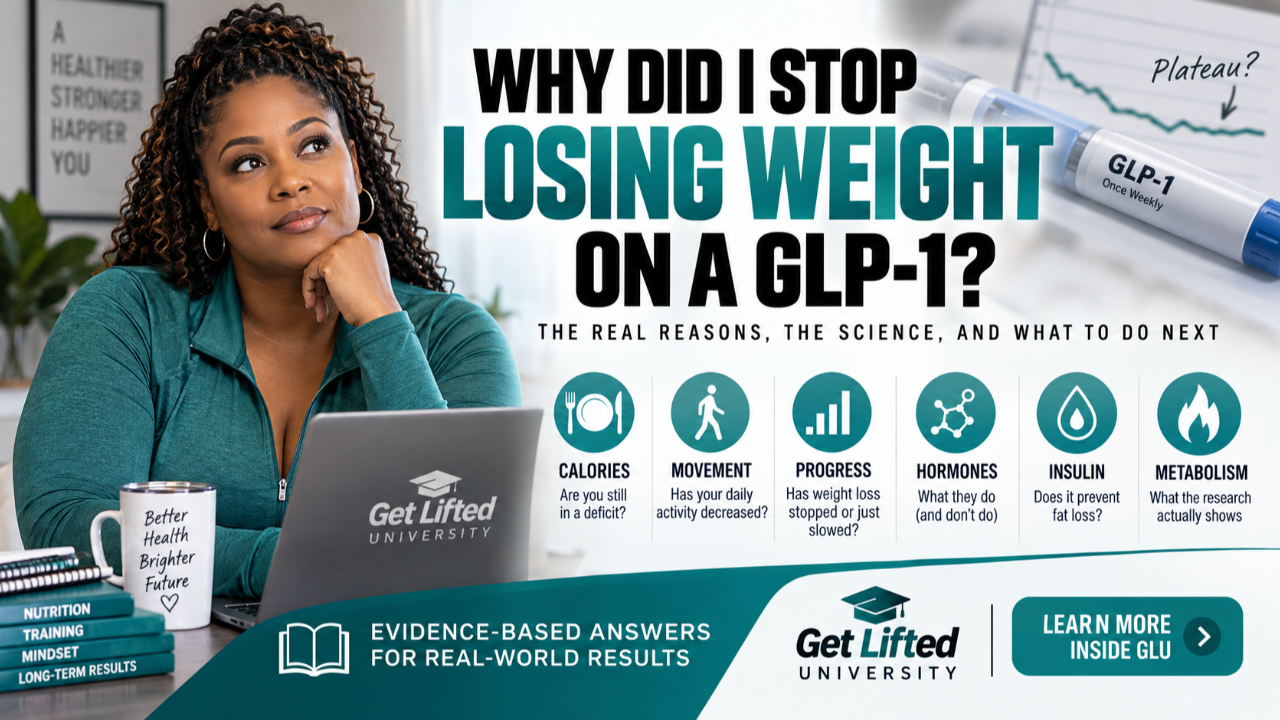
Why Weight Loss Slows or Stops on a GLP-1
Sep 21, 2026Understanding calorie intake, energy expenditure, metabolic adaptation, insulin, hormones, and the physiology of a weight-loss plateau
Abstract
GLP-1 receptor agonists can produce substantial weight loss by altering appetite, satiety, food reward, glucose regulation, and other physiological processes that influence energy intake. However, weight loss typically slows over time and eventually reaches a plateau, even when medication is continued.
A plateau does not necessarily indicate that the medication has stopped working, that insulin resistance is preventing fat loss, that hormones have suddenly become dysfunctional, or that metabolism has been "damaged." Instead, weight-loss plateaus occur when the energy deficit that produced the initial weight loss becomes progressively smaller until average energy intake and energy expenditure once again approach equilibrium.
For someone taking a GLP-1 whose weight loss has slowed, three variables should be examined first: whether calorie intake still produces a deficit, whether daily energy expenditure and movement have declined, and whether weight loss has actually stopped or has simply become slower and more difficult to detect.
How GLP-1 Medications Produce Weight Loss
GLP-1 medications affect several physiological systems. They can improve satiety, decrease hunger and food preoccupation, alter food reward, improve glucose regulation, increase glucose-dependent insulin secretion, suppress glucagon, and influence gastric function. The relative contribution of each mechanism is still being studied. (PubMed)
But one outcome is particularly important for understanding weight loss:
People generally consume fewer calories.
In a randomized trial of adults with obesity, participants receiving semaglutide 2.4 mg consumed approximately 35% fewer calories during an ad libitum meal than participants receiving placebo after 20 weeks of treatment. Semaglutide also reduced hunger and food cravings while increasing fullness and satiety. (PubMed)
A newer 60-week randomized trial provides even stronger evidence that this reduction in intake persists.
Compared with placebo, participants taking semaglutide consumed approximately 292 fewer calories at week 20, 240 fewer calories at week 40, and 270 fewer calories at week 60 during controlled laboratory meals. The investigators concluded that reduced energy intake appears to be a central mechanism through which semaglutide induces and maintains weight loss. (PubMed)
This distinction matters.
A GLP-1 does not make energy balance irrelevant.
It changes several of the biological and behavioral variables that determine energy balance, particularly how much food a person wants to consume and ultimately consumes.
Why Weight Loss Eventually Slows
Weight loss does not normally continue at the same rate indefinitely.
The STEP 5 trial followed adults receiving semaglutide 2.4 mg for 104 weeks. Average weight loss with semaglutide reached approximately 15.2% at two years, but the weight-loss curve began leveling off around week 60 and then remained relatively stable through week 104. (Nature)
That is an important observation.
Participants were still taking semaglutide.
The medication had not suddenly disappeared from their bodies.
Yet weight loss slowed and eventually plateaued.
Researchers studying the physiology of weight-loss plateaus have modeled this process across calorie restriction, semaglutide, tirzepatide, and bariatric surgery. The common feature is that weight loss triggers physiological responses that progressively narrow the gap between energy intake and expenditure. GLP-1 medications can delay this process substantially because they reduce appetite feedback, but they do not eliminate it. (PubMed)
A 2026 modeling analysis of long-term GLP-1 treatment reached a similar conclusion. As body weight decreased, estimated energy expenditure declined and estimated energy intake gradually approached expenditure. Once the two became approximately equal, body weight plateaued despite continued treatment. (PubMed)
A plateau, therefore, is not mysterious.
At the point of weight stability:
Average energy intake is once again approximately matching average energy expenditure.
The question is why.
1. Your Current Calorie Intake May No Longer Produce Weight Loss
Consider a simplified example.
A woman weighs 220 pounds and maintains that weight while consuming approximately 2,500 calories per day.
She begins taking a GLP-1.
Because hunger and food intake decrease, her average intake falls to approximately 2,000 calories per day.
She now has a meaningful energy deficit and begins losing weight.
Eventually she loses 30 pounds and reaches 190 pounds.
The important question is not:
"Am I still eating less than I used to?"
She clearly is.
The important question is:
"Is 2,000 calories still low enough relative to my current energy expenditure to continue producing weight loss?"
Those are completely different questions.
A smaller body generally requires less energy to maintain than a larger body. Resting energy requirements decline as body mass decreases, and the energetic cost of moving the body also falls.
Therefore, an intake that produced substantial weight loss at 220 pounds may produce a much smaller deficit at 190 pounds.
Eventually, it may produce very little deficit at all.
The numbers in this example are illustrative rather than a prediction that every 190-pound person maintains on 2,000 calories. Actual maintenance requirements vary considerably between individuals.
This is exactly why knowing what someone is actually consuming becomes valuable when progress slows.
"I eat less."
"I barely eat."
"I eat healthy."
"My portions are much smaller."
None of these statements tells us how much energy is being consumed.
Food intake also tends to be difficult to estimate accurately. This does not mean people are intentionally dishonest. Human beings simply have substantial difficulty remembering, estimating, and quantifying everything they consume.
The solution is not to become obsessive about calories.
It is to collect enough accurate information to understand the current situation.
2. Energy Expenditure and Daily Movement May Have Decreased
Food intake is only one side of the equation.
Energy expenditure changes during weight loss too.
A person who loses 30, 50, or 80 pounds is carrying substantially less mass throughout the day. Walking, climbing stairs, standing, and completing normal activities now require less energy.
Movement itself can also decrease.
Non-exercise activity thermogenesis, commonly called NEAT, includes energy expended through activities such as walking around the house, standing, chores, occupational movement, fidgeting, and other activity that is not structured exercise.
Research has demonstrated that this component can change during weight loss.
In one study, 140 women lost an average of approximately 25 pounds. Researchers measured total energy expenditure with doubly labeled water and resting expenditure with indirect calorimetry.
Among women who lost weight without exercise training, total energy expenditure, resting energy expenditure, and NEAT all decreased.
Women who performed aerobic or resistance exercise did not experience the same decline in free-living energy expenditure. (PubMed)
That means someone can continue eating substantially less than before starting a GLP-1 while also unknowingly expending less energy.
If calorie intake decreases by 500 calories but expenditure eventually decreases by 300 calories through a combination of lower body mass, lower resting expenditure, less movement, and adaptation, the original deficit is no longer 500 calories.
The gap has narrowed.
This is why actual movement data matter.
A person averaging 8,000 steps during the first six months of weight loss may now be averaging 5,000.
Without measuring it, she may have no idea the change occurred.
3. Weight Loss May Not Have Stopped at All
A third possibility is frequently overlooked:
The person is still losing weight, but the rate has slowed.
Those are not the same thing.
Suppose someone's weekly weight averages look like this:
| Week | Average Weight |
|---|---|
| 1 | 192.1 lbs |
| 2 | 191.6 lbs |
| 3 | 191.1 lbs |
| 4 | 190.7 lbs |
Someone weighing herself intermittently might see several readings between 190 and 192 pounds and conclude:
"My weight hasn't moved in a month."
But the averages show a clear downward trend.
Body weight fluctuates independently of changes in body fat because the scale also reflects water, glycogen, gastrointestinal contents, sodium balance, menstrual-cycle-related fluid changes, and other short-term variables.
As fat loss becomes slower, those fluctuations become proportionally larger than the underlying weekly change in fat mass.
A one-pound water fluctuation can easily hide a quarter-pound or half-pound reduction in body fat.
Therefore, a plateau should not be diagnosed from several days of unchanged scale weight.
The trend matters more than an isolated measurement.
What About Hormones?
Hormones absolutely influence body weight regulation.
Leptin, ghrelin, thyroid hormones, estrogen, progesterone, cortisol, insulin, GLP-1, glucagon, and numerous other signals influence appetite, energy expenditure, glucose metabolism, food reward, body composition, fluid balance, and where fat is stored.
But saying "hormones matter" is very different from saying "hormones explain why energy balance no longer matters."
They do not.
Hormonal changes can modify one or both sides of the energy-balance equation.
They can make someone hungrier.
They can influence spontaneous movement.
They can change resting expenditure.
They can affect fatigue, food intake, glucose control, fluid retention, and body composition.
Those effects can make maintaining an energy deficit easier or harder.
But they do not create a separate pathway through which body fat can continue accumulating indefinitely while energy expenditure exceeds energy intake, or disappear indefinitely while intake exceeds expenditure.
This distinction is especially important for women approaching menopause.
Changes in ovarian hormones during menopause can influence fat distribution, body composition, and other metabolic variables. But controlled interventions continue to demonstrate that postmenopausal women lose weight when interventions create sufficient energy restriction.
In a randomized trial of 439 overweight or obese postmenopausal women, average one-year weight loss was approximately 8.5% with dietary intervention and 10.8% when dietary intervention was combined with exercise. (PubMed)
Hormonal status influences the environment in which weight regulation occurs.
It does not abolish the underlying requirement for negative energy balance to reduce stored body energy.
What About Insulin Resistance?
Insulin is one of the most misunderstood parts of the weight-loss discussion.
Insulin has important effects on glucose uptake, fat storage, fat mobilization, protein metabolism, and many other physiological processes.
Insulin resistance is also clinically important and strongly associated with metabolic disease.
But elevated insulin does not make fat loss impossible when an energy deficit exists.
Controlled feeding experiments help demonstrate this distinction.
In an NIH metabolic-ward study, researchers compared calorie-matched carbohydrate restriction with calorie-matched fat restriction in adults with obesity.
Reducing carbohydrates produced a substantially larger reduction in insulin secretion.
Yet it did not produce greater body-fat loss.
During the controlled intervention, fat restriction actually produced greater measured body-fat loss despite the carbohydrate-restricted diet producing the larger decrease in insulin. (PubMed)
The larger DIETFITS randomized clinical trial included 609 adults and compared healthy low-fat and healthy low-carbohydrate diets for one year.
Average weight loss was approximately 5.3 kg with the low-fat diet and 6.0 kg with the low-carbohydrate diet, with no statistically significant difference.
Importantly, baseline insulin secretion did not predict which dietary approach produced greater weight loss. (PubMed)
GLP-1 trials provide another useful observation.
In STEP 5, participants taking semaglutide eventually reached a weight plateau around week 60.
Yet semaglutide simultaneously improved fasting glucose, HbA1c, and fasting insulin compared with placebo. (Nature)
Think about what that means.
Weight loss plateaued while insulin-related metabolic health was improving.
Therefore, the plateau cannot simply be explained by saying:
"Insulin is high, so the body won't release fat."
Insulin affects metabolism.
But the evidence does not support treating insulin as an independent switch that overrides long-term energy balance.
What About a "Damaged Metabolism"?
This explanation contains a piece of truth that is often taken too far.
Metabolism does change during weight loss.
A smaller person typically burns fewer calories than the same person did at a larger body weight.
Resting expenditure decreases because there is less metabolically active tissue to support.
Movement costs less energy.
Food intake is lower, so the thermic effect of food can decrease.
Daily movement may fall.
There can also be adaptive thermogenesis, meaning energy expenditure decreases somewhat more than would be predicted solely from the reduction in body mass.
That phenomenon is real.
But the available evidence does not support the idea that metabolism commonly becomes permanently "broken."
A systematic review examining 33 studies involving 2,528 participants found evidence of adaptive thermogenesis in many studies, but the magnitude was generally smaller in higher-quality research. Adaptive thermogenesis also appeared to diminish or disappear after periods of weight stabilization and neutral energy balance. (PubMed)
One study examining moderate weight loss estimated adaptive thermogenesis ranging approximately from 65 to 230 calories per day, depending heavily on the mathematical method used to calculate it. (PubMed)
That matters.
A 100- or 200-calorie change can absolutely influence the rate of weight loss.
But that is very different from a metabolism becoming incapable of losing weight.
Metabolic adaptation helps explain why the original calorie deficit becomes smaller.
It does not invalidate the deficit.
In fact, metabolic adaptation is part of the reason the deficit needs to be reassessed as body weight decreases.
The Difference Between Cause and Mechanism
This is where much of the confusion comes from.
Hormones, insulin, appetite, metabolic adaptation, physical activity, medications, sleep, and other variables can all influence how much energy someone eats or expends.
They therefore influence weight regulation.
But when body weight reaches a true long-term plateau, the physiological endpoint is the same:
Average energy intake has become sufficiently close to average energy expenditure that further tissue loss has slowed dramatically or stopped.
That is not an opinion about which factor caused the change.
It is the definition of energy balance.
The clinically useful question is therefore not:
"Do hormones matter?"
Of course they do.
The useful question is:
"Which variable changed enough to eliminate the deficit that previously existed?"
A Practical Way to Evaluate a GLP-1 Weight-Loss Plateau
Before assuming a GLP-1 has stopped working, collect enough information to determine what has actually changed.
First, verify the weight trend. Use consistent measurements and compare weekly averages over several weeks rather than reacting to individual weigh-ins.
Second, verify current food intake. Track consistently for 7 to 14 days. This is not because calorie tracking must be performed forever. It is because you cannot confidently adjust a variable you have never measured.
Third, verify current movement. Compare current average steps, cardio, training, and general activity with the period when weight was decreasing.
Fourth, make one deliberate adjustment. Depending on the data, that may mean modestly reducing calorie intake, increasing daily movement, adding cardio, or combining approaches.
Finally, run the adjustment long enough to evaluate the trend. Normal daily weight fluctuations should not dictate daily changes in the plan.
The process is:
BUILD → RUN → REVIEW → VERIFY → DECIDE
When a Plateau Deserves Medical Evaluation
Energy balance explains the mechanics of body-weight change, but that does not mean every change in appetite, fatigue, weight, or health should be handled by simply eating less.
A prescribing clinician should be involved when there are questions about GLP-1 dosing, persistent or severe side effects, difficulty consuming adequate food or protein, significant gastrointestinal symptoms, suspected thyroid disease or another endocrine disorder, medication interactions, unexpected changes in blood glucose, or other concerning symptoms.
Medical conditions can influence both energy intake and energy expenditure and should be diagnosed and treated appropriately.
The point is not that hormones or metabolism never matter.
The point is that they should not automatically become the explanation for every weight-loss plateau without first determining whether a plateau actually exists and what happened to energy intake and expenditure.
Conclusion
GLP-1 medications can dramatically change the conditions under which weight loss occurs.
They can reduce hunger, improve satiety, alter food reward, improve metabolic health, and make substantial reductions in calorie intake easier to sustain. (PubMed)
But the physiology of weight loss still changes as body weight decreases.
A lighter body requires less energy.
Daily movement may decrease.
Metabolic expenditure can decline.
The original calorie deficit becomes smaller.
And eventually, energy intake and energy expenditure can approach a new equilibrium.
That is why weight loss slows.
That is why plateaus occur.
And that is why learning how much you eat, how much you move, how you train, and how to adjust those variables as your body changes remains important even when a medication is helping control appetite.
The goal should not simply be to reach a lower body weight.
The goal is to understand what is required to maintain that body weight once you get there.
If you’re using a GLP-1, don’t just rely on the medication to do the work. Learn how to manage the results it helps you create.
Inside Get Lifted University, we teach you how to eat while taking a GLP-1, protect your muscle, adjust when weight loss slows, and know exactly what to do when you reach your goal weight.
The goal isn’t just to lose weight.
The goal is to know how to keep it off.
If you want the knowledge, structure, and tools to do that, join Get Lifted University today.
God bless. Let’s work.
References
-
Tronieri JS, et al. Short- and long-term effects of semaglutide 2.4 mg on energy intake, appetite, and food reward: a 60-week, double-blind randomized controlled trial. American Journal of Clinical Nutrition. 2026. (PubMed)
-
Friedrichsen M, et al. The effect of semaglutide 2.4 mg once weekly on energy intake, appetite, control of eating, and gastric emptying in adults with obesity. Diabetes, Obesity and Metabolism. (PubMed)
-
Garvey WT, et al. Two-year effects of semaglutide in adults with overweight or obesity: the STEP 5 trial. Nature Medicine. 2022. (Nature)
-
Hall KD. Physiology of the weight-loss plateau in response to diet restriction, GLP-1 receptor agonism, and bariatric surgery. Obesity. 2024. (PubMed)
-
Nunes CL, et al. Does adaptive thermogenesis occur after weight loss in adults? A systematic review. British Journal of Nutrition. 2022. (PubMed)
-
Hall KD, et al. Calorie for calorie, dietary fat restriction results in more body fat loss than carbohydrate restriction in people with obesity. Cell Metabolism. 2015. (PubMed)
-
Gardner CD, et al. Effect of low-fat vs low-carbohydrate diet on 12-month weight loss and the association with genotype pattern or insulin secretion: the DIETFITS randomized clinical trial. JAMA. 2018. (PubMed)
-
Hunter GR, et al. Exercise training and energy expenditure following weight loss. Medicine & Science in Sports & Exercise. (PubMed)
-
Foster-Schubert KE, et al. Effect of diet and exercise, alone or combined, on weight and body composition in overweight-to-obese postmenopausal women. Obesity. (PubMed)
