
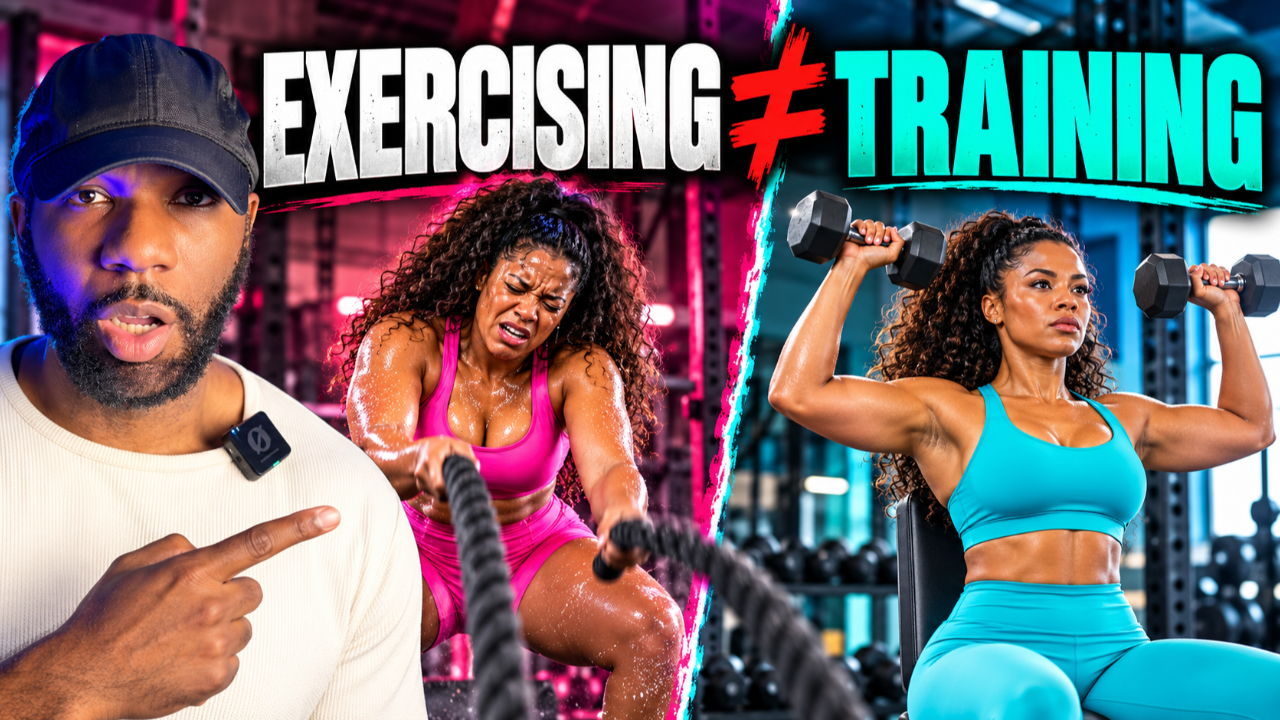
How to Train for the Body You Want
Oct 22, 2026Every year, millions of people commit themselves to working out, joining gyms, and following exercise routines with the expectation that their bodies will eventually reflect the effort they're putting in. They spend hours exercising, pushing through difficult workouts, and measuring their success by how much they sweat, how many calories they burn, or how exhausted they feel afterward. Yet months and sometimes years pass without the physical transformation they originally wanted. The problem is that working out and training for a specific physical outcome are two completely different things. If your goal is to build muscle, lose body fat, and develop a stronger, more defined physique, you need to understand which exercises produce those results and how to organize your training to achieve them.
And your workouts are only one part of the equation. You also need to understand how much food your body requires, how to organize that food around your goals, and how to measure whether your plan is producing results. These are skills that most people never take the time to learn, which explains why they can spend years following different diets and exercise programs without developing a reliable system for managing their bodies.
Exercising vs. Training: Understanding the Difference
Exercise is physical activity that challenges your body. Training is physical activity organized to produce a specific result.
The distinction matters because different types of exercise produce different physical adaptations.
Hypertrophy training focuses on increasing muscle size. Strength training improves your ability to produce force. Muscular endurance training develops your ability to sustain repeated muscular efforts, while cardiovascular training improves your heart, lungs, and overall stamina. Power training develops your ability to produce force rapidly, as demonstrated through explosive movements such as jumping and throwing.
These adaptations overlap, but they're not interchangeable.
For example, someone who spends an hour performing high repetition circuits can develop excellent muscular endurance without making significant improvements in muscle size. Someone who consistently performs progressive resistance training can build muscle and strength without finishing every session exhausted.
The effectiveness of your workout depends on whether the exercises you're performing support the results you're trying to achieve.
Unfortunately, many popular exercises are selected because they're challenging or entertaining rather than because they're the most effective tools for developing muscle.
The Five Worst Exercises for Body Transformation
1. Planks
Planks are among the most commonly prescribed abdominal exercises, particularly in personal training sessions and group fitness classes.
Their primary purpose is developing isometric core stability and muscular endurance. Your abdominal muscles contract to maintain a static position while resisting movement.
However, holding a plank for increasingly longer periods isn't an effective primary strategy for developing larger abdominal muscles.
If your objective is abdominal hypertrophy, exercises such as weighted cable crunches allow you to challenge those muscles through movement while progressively increasing resistance. Hanging knee raises and leg raises offer additional ways to develop abdominal strength through controlled repetitions.
For trunk stability, Pallof presses and farmer's carries provide valuable alternatives.
Instead of measuring how long you can hold a plank, focus on exercises that allow you to progressively challenge the muscles you're trying to develop.
2. Box Jumps
Box jumps are designed to develop explosive power. They challenge your ability to rapidly produce force and coordinate a jump and landing.
They're frequently included in general fitness programs despite their limited value as a primary exercise for building muscle.
If your objective is developing stronger, more muscular legs and glutes, squats, leg presses, lunges, and split squats allow you to apply progressively greater resistance through controlled movement.
For beginners, box jumps introduce additional coordination and landing demands without providing the same opportunities for progressive loading as traditional lower body resistance exercises.
If you're training for explosive athletic performance, train your ability to jump. If you're trying to develop your legs and glutes, prioritize resistance training.
3. Medicine Ball Throw, Catch and Squat
This exercise is especially common in group fitness classes and personal training sessions. Participants throw a medicine ball into the air, catch it, lower into a squat, and repeat.
It combines several movements and quickly becomes exhausting, but that doesn't make it an effective muscle building exercise.
The weight you can repeatedly throw and catch is limited by your ability to control the ball, rather than the strength of your quadriceps and glutes.
That makes it difficult to progressively challenge the lower body muscles compared with exercises such as squats, lunges, and leg presses.
Even performing a traditional goblet squat with the medicine ball provides a more focused lower body training stimulus.
Making an exercise more complicated doesn't automatically make it more effective.
4. Burpees
Burpees combine several bodyweight movements into a continuous conditioning exercise. They elevate your heart rate, challenge muscular endurance, and produce substantial fatigue.
However, combining a squat, plank, push up, and jump doesn't automatically create an effective hypertrophy exercise.
If your goal is developing your chest and triceps, perform challenging push ups or chest presses. If you want stronger legs, perform progressively loaded squats and lunges.
Separating those movements allows you to challenge the intended muscles directly rather than having overall conditioning limit your performance.
Burpees are an effective way to become better at performing burpees. They shouldn't replace structured resistance training when muscle development is your primary objective.
5. Battle Ropes
Battle ropes are commonly used to elevate heart rate and challenge upper body muscular endurance.
Although they involve repeated movement of your shoulders and arms, they aren't an effective primary method for developing those muscles.
If your goal is building larger shoulders, biceps, triceps, and back muscles, exercises such as shoulder presses, lateral raises, curls, triceps extensions, rows, and lat pulldowns allow you to progressively challenge each muscle group.
And if your primary objective is increasing energy expenditure or improving cardiovascular fitness, walking provides a practical activity that you can incorporate consistently throughout your week.
There is no reason to make exercise unnecessarily complicated when simpler methods accomplish your goals more effectively.
How to Train for Muscle Growth
Developing muscle requires more than selecting the right exercises. You also need to understand how to perform them, how much work to complete, and how to increase the demands placed on your body.
One of the most important principles is progressive overload, which involves gradually increasing the challenge your muscles experience.
Imagine starting a dumbbell chest press with 20 pound dumbbells for eight repetitions. After several workouts, you develop enough strength to perform ten repetitions, then twelve. Once you can consistently complete twelve challenging repetitions, you increase the resistance to 25 pounds and begin progressing again.
You've created a measurable system for improving your performance.
Another important variable is training intensity, or how challenging your working sets are.
One method for measuring this is repetitions in reserve, commonly called RIR. If you finish a set and could perform another ten repetitions, the resistance is relatively easy. If you finish with only one or two good repetitions remaining, you've performed a much more demanding set.
For muscle growth, your working sets should generally bring you reasonably close to muscular failure while maintaining controlled technique.
Training volume also matters. This refers to the amount of work you perform, typically measured by the number of challenging sets completed for each muscle group.
For beginners, performing two to three challenging sets per exercise, across three weekly resistance training sessions, provides an effective starting point. Performing exercises through an appropriate range of motion allows you to challenge your muscles through different positions rather than relying on momentum or unnecessarily shortened movements.
Finally, recovery allows your body to adapt. Your muscles need sufficient nutrition, sleep, and time between demanding sessions to repair and develop.
The combination of appropriate exercise selection, progressive overload, challenging sets, and sufficient recovery forms the foundation of effective hypertrophy training.
How to Organize Your Weekly Workouts
Three structured full body resistance training sessions can provide an effective foundation for building muscle, particularly for beginners.
Here's an example of how to organize your week.
Monday: Full Body Workout A
| Exercise | Sets | Repetitions |
|---|---|---|
| Goblet Squat | 3 | 8 to 12 |
| Dumbbell Chest Press | 3 | 8 to 12 |
| Seated Cable Row | 3 | 8 to 12 |
| Romanian Deadlift | 2 | 8 to 12 |
| Weighted Cable Crunch | 2 | 10 to 15 |
Wednesday: Full Body Workout B
| Exercise | Sets | Repetitions |
|---|---|---|
| Leg Press | 3 | 8 to 12 |
| Hip Thrust | 3 | 8 to 12 |
| Dumbbell Shoulder Press | 3 | 8 to 12 |
| Lat Pulldown | 3 | 8 to 12 |
| Pallof Press | 2 | 10 to 12 per side |
Friday: Full Body Workout C
| Exercise | Sets | Repetitions |
|---|---|---|
| Split Squat | 3 | 8 to 12 per leg |
| Romanian Deadlift | 3 | 8 to 12 |
| Incline Dumbbell Press | 3 | 8 to 12 |
| Seated Cable Row | 3 | 8 to 12 |
| Hanging Knee Raise | 2 | 10 to 15 |
Each workout should begin with an appropriate warmup. Select resistance that allows you to perform the prescribed repetitions with controlled technique while making the final repetitions challenging.
But don't simply copy this program and assume you're following an effective training plan. You still need to know whether the exercises are appropriate for your experience, how much resistance you should use, how close to muscular failure you should train, and when to increase the difficulty.
For example, two women might perform the exact same workout, but one could be using weights that challenge her to within two repetitions of failure while the other finishes every set capable of completing another fifteen repetitions. On paper, their workouts look identical. The stimulus their muscles receive is substantially different.
This is why tracking your resistance, repetitions, and performance matters. It allows you to determine whether your training is progressing rather than simply repeating the same exercises every week.
The same level of intentionality needs to be applied to your nutrition.
Your Nutrition Needs a Strategy, Not Another List of Foods to Eat
You've probably heard that you need to eat more protein, reduce your calories, drink more water, eat more vegetables, and avoid overeating.
That advice has been repeated for decades. Yet millions of people continue struggling with their weight because knowing what they should generally be doing is very different from knowing exactly what their own bodies require.
Telling someone to eat 100 grams of protein doesn't explain how much protein their body needs. Telling someone to eat 1,500 calories doesn't establish whether that amount is appropriate for their energy requirements. And telling someone to eat healthier doesn't explain how much food they can consume while losing weight.
Your nutrition needs to be built around your body, your goals, your activity level, and your lifestyle.
That requires understanding several important variables that most people have never been taught to identify.
Do You Know Your Maintenance Calories?
Before you can intelligently manage your weight, you need to understand your maintenance calories.
This is the amount of energy your body requires to maintain its current weight under your existing conditions.
And it's one of the most important numbers in your entire weight management journey.
Without understanding your maintenance requirements, how do you know whether the number of calories you're eating is appropriate for weight loss? How do you determine whether your deficit is too aggressive or too small? And how do you recognize when your energy requirements have changed?
Two women can weigh exactly the same amount and require different calorie intakes because their activity levels, body composition, and other individual characteristics differ.
Yet people routinely begin diets using calorie targets they've found online without understanding whether those numbers make sense for them.
Your maintenance calories are the foundation for determining how much food your body needs to lose, gain, or maintain weight.
And if you've never taken the time to discover yours, you're missing a critical piece of information.
Do You Know How Much You Should Be Eating to Lose Body Fat?
Knowing that you need a calorie deficit is one thing. Knowing the appropriate deficit for your body is another.
An effective fat loss plan should consider your current maintenance requirements, desired rate of weight loss, physical activity, and ability to preserve muscle while losing weight.
Eating as little as possible isn't the objective.
You need an appropriate calorie target that allows you to lose body fat while supporting your resistance training, recovery, and overall health.
And what happens when your weight loss slows?
How do you determine whether you need to adjust your calories, increase your activity, or simply continue following your current plan?
Without understanding the numbers behind your nutrition, every plateau becomes another opportunity to guess, get frustrated, and start looking for a new diet.
Do You Know How Much Protein You Personally Need?
Protein is essential for building and maintaining muscle, particularly when you're losing weight.
But simply telling everyone to eat 100 grams of protein ignores the differences between individuals.
Your protein requirements should account for factors such as body size, lean mass, training demands, and your overall nutrition goals.
Someone trying to lose a substantial amount of body fat while preserving muscle has different considerations from someone maintaining their weight and pursuing additional muscle growth.
And knowing your protein target is only part of the equation.
You also need to understand how that protein fits into your total calorie intake and how to distribute it throughout your normal eating routine.
A protein recommendation without an individualized nutrition strategy is just another number you're hoping will produce results.
Do You Know How to Organize Your Meals Around Your Goals?
Knowing your calorie and protein requirements doesn't automatically mean you know how to eat to meet them.
How many meals should you eat each day? How many calories should you allocate to breakfast, lunch, and dinner? How much protein should those meals contain? How do snacks, desserts, beverages, and restaurant meals fit into your daily intake?
These decisions determine how manageable your nutrition plan becomes.
Someone who prefers two larger meals has different scheduling needs from someone who enjoys three meals and a dessert. Someone who regularly eats at restaurants needs a different level of preparation from someone who cooks nearly every meal at home.
Neither person needs to abandon their lifestyle to lose weight.
They need to understand how to organize their food intake around their individual requirements.
This is where many people struggle. They know they should eat less, but they don't know how to organize the foods they enjoy into a consistent eating structure.
As a result, every day becomes another series of decisions about what to eat, how much to eat, and whether they've consumed too many calories.
An effective nutrition plan should remove much of that uncertainty.
Do You Know Whether Your Plan Is Working?
Even the most carefully designed nutrition plan needs to be evaluated.
Your body weight, calorie intake, daily activity, and training performance provide important information about whether your current approach is producing the intended results.
But knowing which information to monitor is only the beginning.
You also need to understand how to interpret it.
For example, your scale weight can increase even when you're losing body fat because of normal changes in water retention, digestion, and other physiological factors.
On the other hand, you can believe you're maintaining a calorie deficit while your overall food intake is preventing weight loss.
Both situations require different responses.
If you don't understand how to evaluate your results, you can end up changing a plan that's working or continuing a plan that isn't.
Hope is not a strategy.
You need a reliable way to determine whether your training and nutrition are moving you toward your goals.
Do You Know How to Maintain Your Results?
This is the part of weight loss that almost everyone overlooks.
Let's say you successfully lose 40 pounds.
You now weigh less, your body composition has changed, and your energy requirements are likely different from when you began.
How many calories should you eat to maintain your new weight? How should your meals change? What happens if your weight begins increasing again? How do you continue developing muscle without regaining the body fat you've lost?
These questions are just as important as the ones you needed to answer before losing weight.
Too many people spend months learning how to restrict their food intake without ever learning how to maintain the results.
They reach their goal weight, return to their previous habits, and gradually regain what they worked so hard to lose.
Losing weight and maintaining weight require different nutritional objectives, and you need to understand both.
How Many Pieces of the Puzzle Are You Missing?
Think about everything we've covered.
Your training requires more than showing up at the gym. You need to understand exercise selection, training intensity, progressive overload, volume, recovery, and how to measure improvements in strength and muscle development.
Your nutrition requires more than eating healthier. You need to understand your maintenance calories, establish appropriate calorie and protein targets, organize your meals, evaluate your progress, and learn how to maintain your results.
Your daily activity also matters. The amount you move throughout the day influences your energy expenditure, which affects your overall weight management strategy.
Now consider how many of those variables you've been accounting for.
You might have spent years exercising without knowing whether your workouts were designed for hypertrophy, endurance, or cardiovascular fitness.
You might have followed countless diets without ever discovering how much food your body requires to maintain its weight.
You might know that protein is important but have no idea how much you personally need or how to consistently include that amount in your meals.
And you might have successfully lost weight in the past without ever learning how to maintain it.
How can you expect to consistently produce and maintain a specific result when you don't understand the variables responsible for producing it?
This is why weight loss and body transformation require education, structure, and measurable strategies.
And it's why following another workout video or downloading another meal plan isn't going to teach you everything you need to know.
Learn How to Train for the Body You Want
The most valuable thing you can gain from fitness and nutrition education is the ability to understand and manage your own body.
When you understand how your muscles adapt to training, how your body uses energy, how much food you require, and how to evaluate your progress, you can make informed decisions instead of constantly searching for another solution.
That's exactly what we teach inside Get Lifted University and through Get Lifted 1:1 Coaching.
We go beyond simply handing you a workout program or telling you how many calories to eat.
We teach women how to understand their bodies, discover their individual nutritional requirements, organize their meals, develop muscle, lose body fat, and maintain their results.
Because the real value of coaching isn't simply helping someone lose 20, 40, or 60 pounds.
It's teaching them how to achieve those results, understand the process, and develop the skills necessary to maintain them for the rest of their lives.
If you're ready to stop guessing and start learning how to train and eat for the body you want, join Get Lifted University or apply for personalized Get Lifted 1:1 Coaching.
God Bless. Let's work.
