
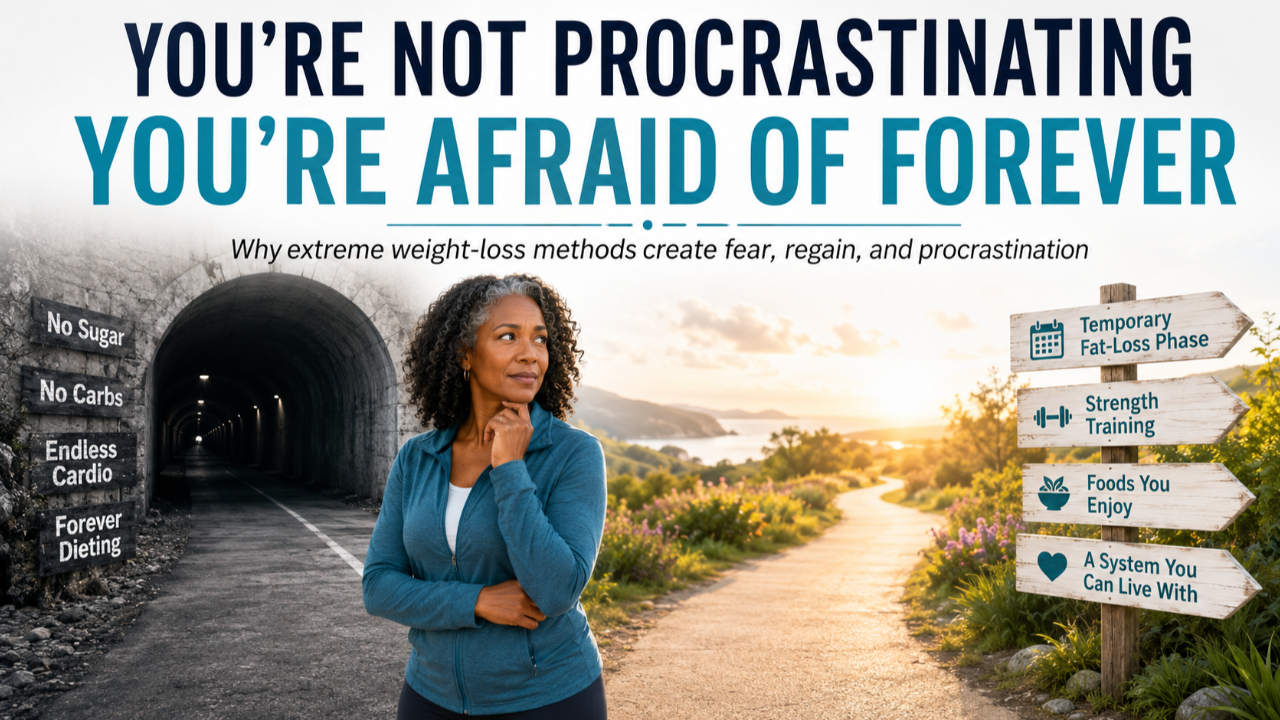
How to Overcome Inertia and Start Moving Forward
Jul 19, 2026An object at rest stays at rest. An object in motion stays in motion. That is not just physics. That is you.
Most people think procrastination is about laziness. It is not. It is inertia. Your body and mind are wired to keep doing whatever requires the least energy today, even when that pattern is costing you tomorrow.
What this actually looks like in real life
It shows up in familiar ways:
- Scrolling past a workout video and thinking I'll start Monday. Then Monday becomes another day you're "too busy" to start.
- Buying the healthy groceries, then letting them sit in the fridge while you order takeout, because cooking felt like one more thing.
- Telling yourself you'll figure out the plan once things calm down at work. Once the kids go back to school. Once the holidays are over.
- Getting dressed for the gym, then finding a reason not to go.
- Knowing exactly what you should be eating, and doing something else anyway.
- Avoiding mirrors, or catching a photo of yourself and feeling a jolt you weren't ready for.
- Standing in front of the closet longer than you should, sorting by what still fits instead of what you actually want to wear.
- Saying no to an invitation. Or going anyway, and spending the whole time distracted by how you feel in your clothes.
- Watching someone else's progress online and feeling proud of them and quietly defeated for yourself, at the same time.
Things never calm down.
It isn't a lack of knowledge. Knowing was never the problem.
None of this means you don't want change. It means the pattern you're in has more force behind it than the plan you're imagining.
Why your brain protects the pattern you already have
Your brain is not designed to make you happy. It is designed to keep you safe. Familiar discomfort feels safer than unfamiliar effort, even when the familiar discomfort is slowly making your life worse.
This is why staying overweight can feel safer than starting a diet. Not logically safer. Emotionally safer. You know what tomorrow looks like if nothing changes. You do not know what tomorrow looks like if you actually commit, actually try, and risk not seeing results.
Some part of you would rather stay disappointed in a familiar way than risk being disappointed in a new one.
This is not a character flaw. This is not weakness. This is a protective mechanism doing exactly what it was built to do. It is just aimed at the wrong target.
Why waiting makes it worse, not easier
Every day you delay, the gap widens. Not just the gap between your current body and your goal. The gap between who you believe you are and who you want to become.
At first, missing a few workouts feels like a scheduling issue. A few months later, it starts to feel like evidence.
Maybe I'm just not someone who follows through. Maybe this isn't for me. Maybe I've tried enough times to know how this ends. Maybe this is just what happens as you get older. Maybe the version of me from five years ago isn't coming back.
This is the part most people never say out loud, even to themselves. The longer the gap stays open, the more it stops feeling like a habits problem and starts feeling like an identity problem.
Starting no longer feels like adjusting your routine. It starts to feel like admitting something uncomfortable about who you are.
This is why the first step gets harder the longer you wait. The workout does not get harder. The diet does not get harder. The story you are telling yourself about yourself gets harder to interrupt.
What this is actually about
This was never only about the number on the scale. It's about the photo you almost didn't take at your daughter's birthday. It's about the energy to keep up with your kids without needing to sit down halfway through. It's about walking into a room and feeling like yourself again, not like you're hiding.
Losing weight is the visible goal. Underneath it is something quieter: wanting to feel at home in your own body again.
Why past failed attempts make this worse, not better
If you have tried before and it did not stick, inertia has an extra layer working against you.
It is not just I have never done this. It is I have done this, and it didn't work, so why would it work this time.
Every failed attempt at extreme dieting adds weight to that belief. Every "January reset" that fell apart by February adds weight to it too. So does every time you white-knuckled your way through a few weeks before old habits crept back in.
Each one becomes proof, or at least it feels that way, that you are the reason it didn't work.
In reality, the method was often the problem. Not you. But inertia does not care about that distinction. It just uses your history as evidence that staying still is safer than trying again.
Why willpower was never going to be enough
Most people assume the missing ingredient is discipline. If they just wanted it badly enough, they would find a way.
This belief keeps people stuck longer than almost anything else. It turns every failed attempt into a referendum on their character instead of a flaw in their approach.
Willpower is a limited resource. It is highest in the morning and weakest at the end of a long day, which is exactly when most people are making decisions about dinner, snacking, and whether to skip tomorrow's workout.
Relying on willpower to overcome inertia is like relying on a phone at 3 percent battery to get you through the whole day. It might work once. It will not hold up as a long-term strategy.
This is why extreme plans fail so often. They are built entirely on willpower, with nothing underneath to catch you when willpower runs low, which it always eventually does.
What actually breaks inertia
Inertia is not broken by motivation. Motivation is unreliable. It is not broken by a stronger will either, because will is finite and inertia is patient.
Inertia is broken by structure. By something external to your mood on any given day that keeps the motion going even when you don't feel like it.
This is the part most people are missing when they try to do this alone. They are relying entirely on internal forces, motivation and willpower, to overcome something that is fundamentally about external patterns. That is like trying to stop a rolling ball with your mind instead of your hand.
What actually works is a system that removes the need to rely on how you feel that day.
A plan for what to eat that doesn't require decision-making at 6pm when you're exhausted. A training schedule that tells you what to do instead of asking you to find the motivation to figure it out. Accountability that catches you in the moment you're about to quit, instead of leaving you to notice on your own three months later.
Why this is not something most people can build alone
If building that kind of system were simple, inertia would not be this common.
This was never about information. Most people already know that vegetables are better than fast food and that walking is better than sitting. The problem was never what to do.
The problem is having something in place that keeps you doing it on the days your motivation disappears, your schedule falls apart, or your old patterns start pulling you back.
That is the entire difference between people who start and stall again, and people who start and never look back. It was never about who wanted it more.
It was about who had a system strong enough to survive the days when wanting it wasn't enough.
Get Lifted University Is Here to Help You Transform Your Body and Health
Inside Get Lifted University, you’ll get the guidance, coaching, and step-by-step system you need to lose weight, improve your nutrition, build strength, and create a fit and healthy lifestyle you know how to maintain.
No more guessing. Follow the process, get the support, and keep moving toward your goals.
Want to Work Directly With Coach Dom?
Click Here to Apply for 1-on-1 Coaching
God Bless.
Let’s work.
Coach Dom
