
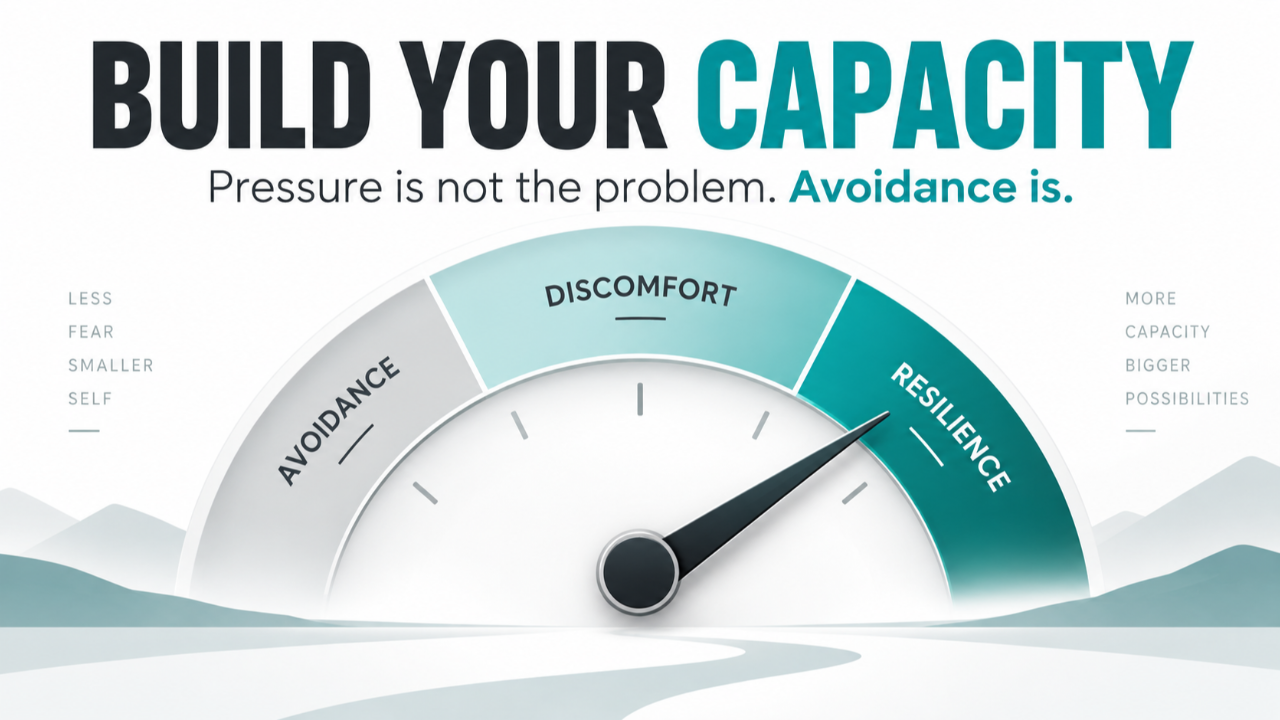
Pressure, Avoidance, and Building Resilience
Sep 16, 2026Pressure, Avoidance, and Building Resilience
You can desperately want to change your life while simultaneously avoiding the experiences required to change it.
You want to lose weight, but avoid stepping on the scale or tracking what you eat. You want to become stronger, but returning to the gym means confronting where your strength is today.
That does not necessarily mean you do not care enough.
Sometimes you are not avoiding the goal.
You are avoiding the discomfort associated with pursuing it.
That distinction matters because if discomfort becomes a signal to retreat, achieving almost any meaningful goal becomes increasingly difficult.
You Can Want Success and Still Be Afraid of Failure
There is a popular idea that people today simply care less about achievement. Research suggests the situation is more complicated.
A 2026 meta-analysis published in Psychological Bulletin examined more than 82,000 college students across the United States, Canada, and Britain. Researchers found increases over time in several forms of perfectionism, including higher expectations, greater concern about making mistakes, doubts about decisions, and the perception that other people expect perfection.
So the problem may not be that we want success less.
We may feel more pressure to succeed while becoming increasingly concerned about what failure means.
That creates an important psychological conflict.
If failure is simply information, you can try, learn, adjust, and continue.
But if failure begins to feel like evidence about who you are, trying becomes much more threatening.
Weight loss can easily become this way.
A higher weigh-in is no longer just a number. It feels like proof that you failed.
Struggling in the gym is no longer simply your current fitness level. It feels like proof of how far you have fallen.
Discovering that you are eating more than you thought feels different when you interpret it as a personal failure instead of useful information.
Research has connected fear of failure with procrastination, particularly when perfectionistic expectations are involved.
And that is where avoidance becomes tempting.
Avoidance Does Something You May Not Realize
Avoidance works because it often makes you feel better immediately.
Imagine you expect the scale to be higher this morning.
You decide not to weigh yourself.
Your anxiety decreases.
That relief teaches your brain something:
When something makes me uncomfortable, avoiding it makes me feel better.
Psychologists call this type of learning negative reinforcement. An unpleasant feeling disappears after a behavior, which makes that behavior more likely to happen again.
That means avoidance does more than delay action.
It can train you to escape whenever discomfort appears.
That is the bigger problem.
If you repeatedly avoid the scale, tracking, exercise, difficult conversations with yourself, or anything else that produces uncomfortable information, you get fewer opportunities to discover that you can actually handle what happens.
Avoidance reduces discomfort today while potentially making you less prepared to handle it tomorrow.
Confidence Is Not Knowing You Will Succeed
We often think confidence means believing everything will work out.
A more useful form of confidence is:
I believe I can handle what happens even if everything does not go perfectly.
That kind of confidence is built through experience.
You see a disappointing weigh-in and continue.
You have an imperfect day of eating and return to your normal structure at the next meal.
You realize something in your plan is not working, make an adjustment, and keep going.
Each experience gives you evidence that discomfort, disappointment, and mistakes do not have to end the process.
Psychologists often discuss this through the concept of psychological flexibility, your ability to experience difficult thoughts and emotions without allowing them to completely control your behavior.
A 2024 systematic review and meta-analysis involving more than 9,000 participants found that improvements in psychological flexibility, including greater acceptance and committed action, were associated with improvements in psychological distress.
Resilience is not becoming someone who never feels discouraged.
Resilience is becoming someone who can feel discouraged and still make a productive decision.
Acceptance Does Not Mean Resignation
Acceptance is another idea that is easily misunderstood.
Acceptance does not mean you have to be satisfied with everything about your current situation.
It means being willing to see reality clearly.
You can accept that you weigh more than you want to weigh.
You can accept that your nutrition has become inconsistent.
You can accept that you are not as physically capable as you once were.
You can accept that previous attempts did not produce lasting results.
Then you decide what to do with that information.
There is a major difference between:
“This is where I am.”
and:
“This is where I have to stay.”
Research on self-compassion supports this distinction. In a series of experiments, people who responded to personal failure with greater self-compassion actually demonstrated greater motivation to improve, address weaknesses, and try again.
You do not have to beat yourself up to change.
But you also do not have to protect yourself from every uncomfortable truth.
Healthy acceptance allows you to see reality without turning reality into your identity.
What This Means for Weight Loss
Weight loss is not a separate journey you need to go on.
It is an outcome that comes from the lifestyle you build.
If the way you eat, move, train, recover, and respond to setbacks consistently supports a leaner, stronger, healthier body, your body will begin to reflect that lifestyle.
That is why learning how to handle discomfort matters so much.
The scale will fluctuate.
Progress may slow.
You will make mistakes.
Motivation will change.
Parts of your plan may eventually need to be adjusted.
Long-term success does not require preventing all of those things from happening.
It requires becoming better at responding when they do.
A higher weigh-in becomes information.
A missed workout leads to the next workout.
A plateau leads to reviewing your calories, movement, training, and consistency.
You stop treating every uncomfortable moment as evidence that the entire process is failing.
That is an important shift.
Because the goal is not to become someone who is constantly “trying to lose weight.”
The goal is to become someone whose lifestyle naturally supports a fit, lean, strong, healthy body.
And that requires learning how to continue when parts of the process are uncomfortable.
Take-Home Point
You may not need more motivation, more confidence, or another attempt at finding the perfect plan.
You may need to become better at tolerating the normal discomfort that comes with changing your life.
Avoidance feels protective because it gives you immediate relief. But every time you automatically escape something difficult, you lose an opportunity to learn that you can handle it.
Every time you face reality, take the next productive action, recover from a mistake, or continue after disappointment, you build evidence in the opposite direction:
I can handle this.
That is how resilience grows.
The Question
When something about this process makes me uncomfortable, what should I do?
The Answer
First determine whether what you are experiencing is harmful or simply difficult.
If something is genuinely harmful, unsafe, or damaging your health, it should be addressed.
But if it is simply uncomfortable because you are disappointed, uncertain, embarrassed, frustrated, or afraid of failing, escaping the feeling should not automatically become the goal.
Instead, focus on taking the next useful action.
Action Steps
-
Identify what you are avoiding. Be specific. Is it the scale, tracking, exercise, looking at your progress, or admitting that your current routine is not working?
-
Identify what you are trying not to feel. Disappointment? Embarrassment? Uncertainty? Fear of failure? Recognizing the emotion helps you separate the feeling from the action you need to take.
-
Separate the fact from the story. “My weight increased two pounds” is a fact. “I always fail at weight loss” is a story you attached to the fact.
-
Take the next productive action instead of seeking immediate relief. Weigh yourself. Track the meal. Complete the next workout. Return to your normal routine. Review the data. Adjust when necessary.
-
Practice recovering instead of restarting. Success is not proving that you never make mistakes. It is reducing how long a mistake controls what you do next.
You are not trying to create a life without pressure, mistakes, disappointment, or uncertainty.
You are building your ability to experience those things without abandoning yourself or the behaviors that move you forward.
The goal is not to stay on a weight-loss journey forever.
The goal is to build a lifestyle you can live that naturally leads to, and helps you maintain, a fit, lean, strong, healthy body.
References
Breines, J. G., & Chen, S. (2012). Self-compassion increases self-improvement motivation. Personality and Social Psychology Bulletin, 38(9), 1133–1143.
Cho, M., & Lee, Y. S. (2022). The effects of medical students' self-oriented perfectionism on academic procrastination: The mediating effect of fear of failure. Korean Journal of Medical Education, 34(2), 121–129.
Curran, T., Hill, A. P., & Pose, P. M. (2026). Perfectionism is accelerating over time: A cross-temporal meta-analytic review of 35 years of college student data. Psychological Bulletin, 152(3), 255–287.
Macri, J. A., & Rogge, R. D. (2024). Examining domains of psychological flexibility and inflexibility as treatment mechanisms in acceptance and commitment therapy: A comprehensive systematic and meta-analytic review. Clinical Psychology Review, 110, 102432.
