
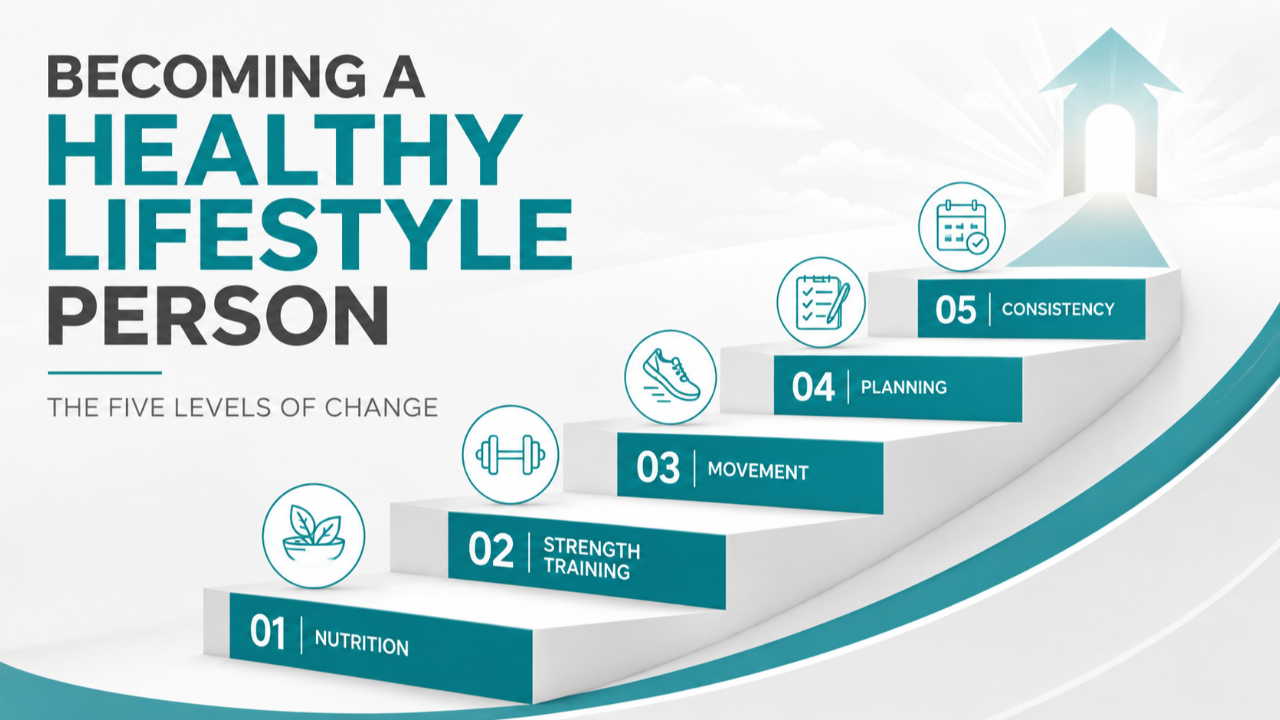
Becoming a Healthy Lifestyle Person: The Five Levels of Change
Aug 25, 2026The ultimate goal of weight loss is to become a Healthy Lifestyle Person: someone whose normal patterns of eating, movement, exercise, recovery, and self-monitoring support a healthier body weight and long-term physical health.
Reaching a goal weight is only one part of that process. The larger challenge is developing a lifestyle capable of supporting that weight after the intentional weight-loss phase ends. A person who has learned how much they need to eat, exercises consistently, remains physically active, monitors meaningful changes, and adjusts when necessary is far better prepared for long-term maintenance than someone whose behaviors exist only while actively dieting.
This is why weight management cannot be understood only as a question of what someone knows. Most adults are already aware that exercise, nutritious food, appropriate portions, and physical activity are important. Knowledge alone, however, does not determine behavior. Psychology, habits, expectations, emotional responses, personal standards, and the ability to follow through all influence whether that knowledge is consistently applied.
The more useful question is not simply, “What do I need to do?” It is also, “What kind of person consistently lives this way?”
Before someone can become a Healthy Lifestyle Person, it is helpful to understand how they are currently operating. The five levels below describe common patterns of behavior and thinking that can influence weight management. They are not measures of personal value, intelligence, or character, nor is every person expected to fit perfectly into one category. Their purpose is to create a practical framework for identifying a current pattern and understanding what needs to develop next.
Level 1: The Reactive Person
The Reactive Person has relatively little structure around health behaviors. Eating, exercise, and activity are largely determined by immediate circumstances rather than by an established routine.
Food choices may depend on hunger, convenience, cravings, stress, mood, social situations, or whatever happens to be available. Exercise may occur when motivation and free time align, but it has not yet become a dependable part of the week. There may also be limited awareness of calorie intake, portions, protein, daily movement, or how much food the body requires to maintain its current weight.
How Someone Reaches This Level
Reactive behavior is easy to develop because the modern environment requires very little intentionality to remain sedentary or consume more energy than the body requires. Food is widely available, many occupations involve prolonged sitting, transportation reduces the need for physical movement, and entertainment frequently occurs in sedentary settings.
Psychology can reinforce the pattern. All-or-nothing thinking is especially common at this level. A person may believe that a workout is not worthwhile unless the entire session can be completed, or that eating beyond the intended amount at one meal means the rest of the day no longer matters. A difficult week can become a reason to postpone healthy behaviors altogether.
Common thoughts include:
-
“I already messed up today.”
-
“I will start again Monday.”
-
“There is no point unless I can do it correctly.”
-
“I do not have enough time for the full workout.”
-
“This week is already ruined.”
The primary problem is usually not one major decision. It is the accumulation of many small decisions made without sufficient awareness or structure.
Common Characteristics
A Reactive Person may have:
-
Little consistent exercise
-
Low levels of routine daily movement
-
Frequent spontaneous eating
-
Limited knowledge of actual calorie intake
-
Minimal meal structure
-
Repeated periods of starting and stopping
-
Limited use of objective feedback such as body weight or food tracking
-
A tendency to wait for motivation before taking action
Progressing to Level 2
The first task is not perfection. It is awareness.
Someone at this level needs enough information to understand the relationship between their current behavior and their current results. That can include tracking normal food intake, monitoring body weight, observing daily movement, identifying situations that lead to unplanned eating, and comparing planned workouts with workouts actually completed.
This process begins to replace assumptions with evidence. Instead of simply believing that weight gain or difficulty losing weight is unexplained, the person develops a clearer understanding of the behaviors that may be contributing to the outcome.
Level 1 begins to change when someone becomes willing to observe their lifestyle accurately and intentionally plan what happens next.
Level 2: The Planner Who Does Not Follow Through
The Planner has moved beyond limited awareness. They may understand calories, protein, exercise, meal preparation, steps, and many of the principles required for weight management. They may also spend considerable time planning.
The limitation at this level is the gap between intention and execution.
Someone can purchase healthy food, create a workout schedule, download a tracking application, set a calorie target, or establish a new goal without consistently performing the behaviors required to produce the desired result. Planning is valuable, but it has little effect when it repeatedly fails to translate into action.
How Someone Reaches This Level
Planning itself can create a sense of progress. Choosing a new program, preparing for a new week, buying exercise equipment, or researching another nutrition strategy can temporarily increase motivation. The difficulty occurs when the excitement associated with beginning something is stronger than the ability to continue it.
Over time, this can produce a repeated cycle of planning, beginning, losing momentum, stopping, and planning again.
The person may accumulate substantial knowledge while developing relatively little consistency. They may accurately explain what they should be doing while simultaneously struggling to perform those behaviors for more than short periods.
Psychologically, the Planner may also set expectations based on the person they hope to be rather than the behavior they have demonstrated they can currently sustain. A highly ambitious schedule may therefore look excellent on paper while being poorly matched to everyday life.
Common Characteristics
This level may include:
-
Exercise performed consistently for short periods
-
Food tracking that starts and stops
-
Multiple unfinished programs
-
Structured weekdays followed by unstructured weekends
-
Repeated attempts at meal preparation
-
Frequent changes in nutrition or exercise strategy
-
Considerable knowledge with inconsistent application
-
Plans that depend heavily on high motivation
Progressing to Level 3
The next stage requires developing follow-through.
Rather than adding more complexity, the Planner usually benefits from reducing the number of commitments and increasing the consistency with which they are completed. Three dependable strength-training sessions are more useful than planning six and completing two. A small group of repeatable meals may be more effective than continually attempting to create an ideal menu. A realistic movement target is more useful than an ambitious target that is repeatedly abandoned.
The psychological task is to begin evaluating success according to execution rather than intention.
A useful question becomes: “What am I prepared to do consistently, including during ordinary and difficult weeks?”
Level 2 is passed when planning becomes a tool for action rather than a substitute for it.
Level 3: The Negotiator
The Negotiator generally has both knowledge and experience. They have demonstrated that they can exercise, track food, plan meals, increase movement, and make progress. The central difficulty is that important health behaviors remain subject to frequent internal negotiation.
At this level, the issue is usually not a lack of understanding. It is that the person repeatedly grants themselves exceptions to behaviors they have already decided are important.
How Someone Reaches This Level
Negotiation often begins with reasonable exceptions. A workout is moved because the day becomes unusually busy. Food tracking is skipped during a special event. A restaurant meal exceeds the normal calorie target.
None of these events is inherently problematic.
The pattern becomes limiting when exceptions become the normal response to inconvenience, fatigue, stress, cravings, social pressure, or reduced motivation.
Common negotiations include:
-
“I will train tomorrow instead.”
-
“I will track again after the weekend.”
-
“Today was stressful, so I deserve this.”
-
“I already exceeded my calories, so today no longer matters.”
-
“I will become serious again next week.”
The Negotiator often understands exactly what is happening. The difficulty is that immediate feelings and circumstances continue to have excessive authority over long-term decisions.
This is an important psychological transition because healthy behavior cannot remain entirely dependent on motivation. Motivation naturally changes. So do energy, stress, schedules, hunger, and mood. A stable lifestyle requires some behaviors to continue even when the desire to perform them is temporarily reduced.
Common Characteristics
The Negotiator may demonstrate:
-
Regular exercise with frequent unnecessary skips
-
Good knowledge of nutrition and calorie intake
-
Periods of accurate tracking
-
Established meals and routines
-
Progress during periods of high consistency
-
Numerous self-created exceptions
-
Significant loss of structure on weekends
-
Difficulty maintaining routines during travel, holidays, stress, or fatigue
-
Repeated intentions to compensate later for current decisions
At this level, more information often provides little additional benefit. The next development is the establishment of personal standards.
Progressing to Level 4
A personal standard is a behavior that has become sufficiently important that it is no longer reconsidered from the beginning every day.
For one person, that standard might be strength training three times each week. Another may establish standards around food awareness, daily movement, protein intake, or regular body-weight monitoring.
Standards should not be confused with rigidity. Circumstances still require flexibility. A workout may need to be shortened, moved, or modified. Nutrition may need to change while traveling. Daily movement may decrease temporarily during illness or a demanding work period.
The distinction is that the person adapts the behavior rather than abandoning the larger commitment.
Level 3 begins to change when fewer important health behaviors require repeated internal debate.
Level 4: The Consistent Person
The Consistent Person has developed reliable patterns of behavior. Exercise, nutrition, movement, and self-monitoring are no longer limited to periods of high motivation or ideal circumstances.
Consistency does not mean perfect adherence. It means that behavior has become sufficiently predictable that occasional deviations no longer determine the overall pattern.
How Someone Reaches This Level
Consistency develops through repeated follow-through. Each completed workout, planned meal, walk, tracking day, and return to routine provides evidence that the person can depend on themselves to act according to established priorities.
This process gradually develops self-efficacy, the belief that one is capable of performing the behaviors required to manage a situation or achieve an outcome. That belief is not created merely through positive thinking. It is strengthened through repeated successful experiences.
This is one reason returning to normal behavior after an imperfect day is so important. Each successful return demonstrates that a disruption does not have to become an abandonment of the larger lifestyle.
The Consistent Person therefore becomes less vulnerable to the all-or-nothing thinking common at earlier levels. A missed workout is treated as a missed workout rather than evidence that the entire week has failed. A restaurant meal is treated as one meal rather than permission to disregard nutrition until Monday.
Common Characteristics
This level commonly includes:
-
Regular strength training
-
Consistent daily movement
-
An understanding of calorie needs
-
Adequate protein intake
-
Reliable meal patterns
-
Periodic body-weight monitoring
-
The ability to intentionally create a calorie deficit
-
The ability to return to maintenance
-
Reasonable behavior during vacations and social events
-
Flexibility during difficult periods without complete abandonment of routine
-
Relatively quick correction when habits begin moving in the wrong direction
The psychological shift is important. The person no longer interprets every deviation as a failure requiring a new beginning. They understand that long-term outcomes are determined by patterns, not isolated events.
Progressing to Level 5
The final transition occurs when these behaviors are no longer understood primarily as tools for losing weight.
A person can be highly consistent during a diet and still view those behaviors as temporary obligations. If exercise, food awareness, movement, and monitoring disappear once the goal weight is reached, then consistency has not yet matured into a sustainable lifestyle.
The question at this stage is therefore straightforward:
Would these behaviors continue if there were no additional weight to lose?
Progression to Level 5 requires building a way of living that remains appropriate during maintenance, not merely during a calorie deficit.
Level 5: The Healthy Lifestyle Person
The Healthy Lifestyle Person has integrated the major behaviors required for long-term health and weight management into normal life.
This does not mean that the person always eats perfectly, never misses a workout, maintains the exact same body weight throughout the year, or organizes every decision around health. Those expectations would be unrealistic and unnecessary.
The defining feature is that healthy behavior has become sufficiently established that temporary disruptions do not fundamentally change the person's lifestyle.
The Psychology of a Healthy Lifestyle Person
At this level, several important psychological changes have occurred.
Health is understood as an ongoing responsibility rather than a temporary project. Body weight is viewed as the product of long-term patterns rather than individual meals. Exercise is valued for strength, physical capacity, health, and function rather than being used solely to compensate for eating.
The Healthy Lifestyle Person can tolerate normal discomfort without interpreting it as a reason to abandon the process. Hunger can sometimes occur without requiring an immediate response. A difficult workout does not mean exercise is inappropriate. A stressful week may require a modified routine rather than no routine.
There is also greater psychological flexibility. When circumstances change, the person adjusts the strategy while preserving the underlying objective. The exact workout, meal structure, calorie intake, or activity level may change throughout different phases of life, but attention to health remains.
Most importantly, the person no longer depends on continually “starting over.” Temporary deviations are addressed within the existing lifestyle.
What This Lifestyle Typically Includes
A Healthy Lifestyle Person generally:
-
Strength trains consistently
-
Maintains regular daily movement
-
Uses cardiovascular exercise appropriately
-
Understands approximately how much food their body requires
-
Can assess or track food intake when necessary
-
Consumes sufficient protein
-
Includes nutritious foods regularly
-
Enjoys favorite foods without routinely abandoning structure
-
Can navigate restaurants, vacations, holidays, and celebrations
-
Monitors body weight or other meaningful indicators periodically
-
Responds to unwanted trends before they become significantly larger problems
-
Gives appropriate attention to sleep and recovery
-
Modifies their approach as age, health, schedule, activity, and goals change
Occasional weight gain, missed workouts, periods of reduced activity, or less structured nutrition can still occur. The distinction is that these events remain temporary variations within an established lifestyle rather than the beginning of another cycle of abandonment and restarting.
Understanding Your Current Level
The purpose of this framework is not to encourage someone to label themselves permanently. It is to identify the psychological and behavioral pattern that most accurately describes how they are currently living.
Different levels require different solutions.
The Reactive Person primarily needs awareness and structure. The Planner needs greater follow-through. The Negotiator needs clearer standards and less dependence on momentary feelings. The Consistent Person needs to ensure that healthy behaviors can continue outside an active weight-loss phase. The Healthy Lifestyle Person continues maintaining and adapting those behaviors over time.
Attempting to solve the wrong problem can create unnecessary frustration. Someone who already understands nutrition does not necessarily need more nutrition education. Someone who plans extensively may not need another plan. Someone who repeatedly negotiates with established commitments may not need additional motivation. Progress depends on identifying the actual limitation and addressing it directly.
This is also why the goal is not to imitate Level 5 behavior for a brief period. A person can temporarily follow a highly structured diet or demanding exercise program and produce substantial physical change. That does not necessarily mean the psychological and behavioral foundations required for long-term maintenance have been established.
The more durable approach is progressive development.
Awareness creates the foundation for intentional behavior. Intentional behavior must become reliable. Reliable behavior develops into standards. Standards practiced over time create consistency. Consistency that remains after the weight-loss phase eventually becomes a lifestyle.
The central question therefore changes from “What do I need to do to lose weight?” to two more useful questions:
“Which level most accurately describes how I am currently living?”
“What psychological and behavioral changes are required for me to function at the next level?”
Weight loss may be one outcome of that process, but the larger objective is to become the kind of person whose ordinary lifestyle supports the body weight, physical capacity, and health they intend to maintain.
