
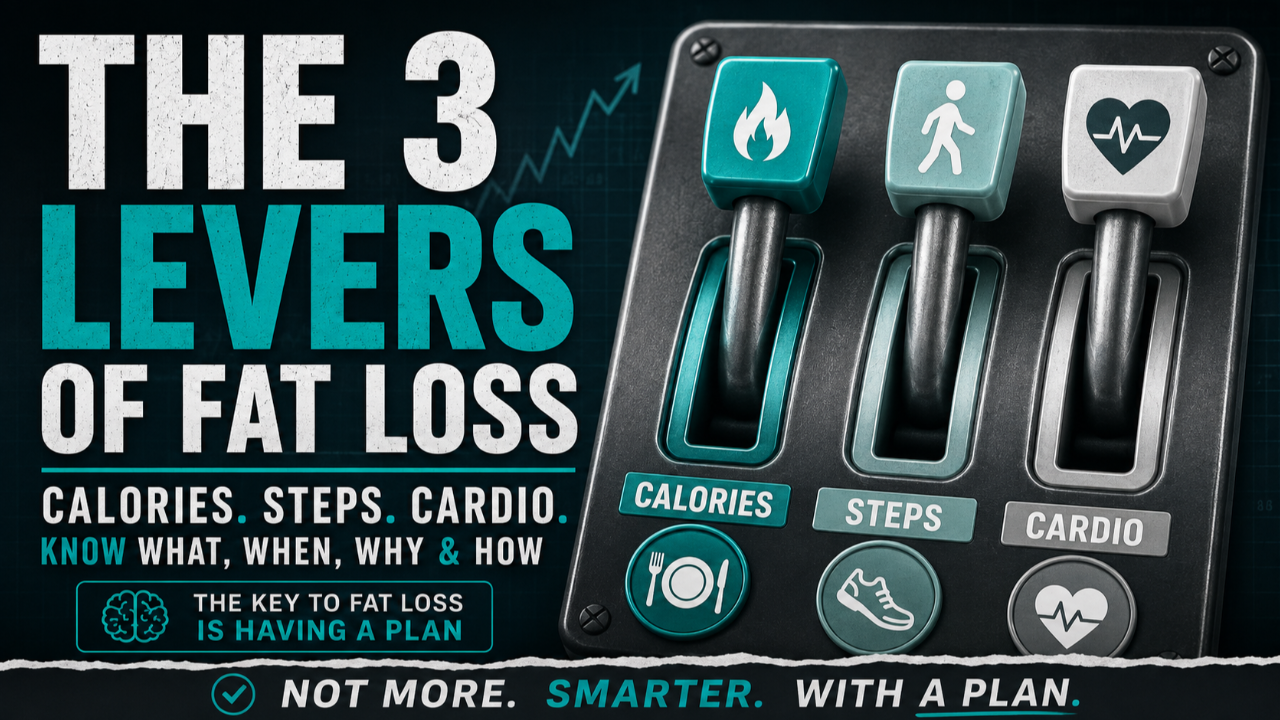
The 3 Levers of Fat Loss
Aug 19, 2026Most people are taught to approach fat loss as a collection of tactics.
Eat fewer carbohydrates. Fast longer. Work out harder. Do more cardio. Hit 10,000 steps. Stop eating after a certain time. Try another diet. Add another workout.
When progress is not happening as quickly as expected, the default response is usually the same:
Do more.
Eat less. Walk more. Add cardio. Train harder.
But beneath nearly every successful fat-loss strategy is a much simpler physiological reality.
To lose body fat, the body must expend more energy than it receives over time. Many processes contribute to total daily energy expenditure, but from a practical coaching standpoint, there are three primary levers we can intentionally manipulate to influence the size of that energy deficit:
Calories. Steps and daily movement. Cardio.
Understanding those three levers makes fat loss considerably easier to understand.
But knowing that the levers exist is only the beginning.
The real skill is knowing which lever to use, why you are using it, when it should be used, how much it should be changed, and how long that change needs to remain in place.
That is the difference between simply following a diet and actually understanding how to manage fat loss.
First, Understand the Energy Balance Behind Fat Loss
Your body is continuously using energy.
Energy is required to keep your heart beating, lungs functioning, brain operating, organs working, body temperature regulated, food digested, muscles moving, and countless other biological processes functioning.
Total daily energy expenditure is commonly divided into several major components: resting energy expenditure, the thermic effect of food, non-exercise activity thermogenesis, and intentional exercise.
For body fat to be lost, energy intake must remain below energy expenditure long enough for the body to draw on stored energy.
That fundamental principle is well established.
Where weight loss becomes more complicated is that the human body is not a static calculator.
Body weight changes. The energy required to move the body changes. Food intake can influence the thermic effect of feeding. Physical activity can change. Spontaneous movement can change. Adaptive changes in energy expenditure can occur during weight loss.
This is why sophisticated models such as the National Institutes of Health Body Weight Planner do not assume that a fixed calorie reduction produces an identical amount of weight loss indefinitely. The model accounts for the dynamic relationship between calorie intake, physical activity, body weight, and energy expenditure over time.[1]
The physiology is dynamic.
The primary variables we deliberately manipulate, however, remain remarkably simple.
We can reduce the amount of energy coming in through food and beverages. We can increase the amount of everyday movement occurring throughout the day. We can increase intentional aerobic exercise.
Those are the three levers.
Lever 1: Calories
Calories represent the energy entering the system through food and beverages.
Suppose a woman has been maintaining her body weight while consuming an average of approximately 2,300 calories per day. If her average intake decreases to 1,900 calories while the rest of her lifestyle remains reasonably similar, she has made a meaningful change to the energy balance equation.
That does not mean we should automatically declare that she now has an exact 400-calorie daily deficit. Energy expenditure is dynamic, food tracking is imperfect, and human behavior is not conducted inside a metabolic laboratory.
What we can say with confidence is much simpler:
Less energy is entering the system.
This is why calorie intake is such a powerful fat-loss lever.
Reducing food intake can create a substantial change in energy balance without requiring additional hours of exercise. It is also considerably easier to quantify than many components of energy expenditure.
But calories have a cost.
Every time calories are reduced, there is less food available to eat.
As intake becomes progressively lower, hunger may increase, meal size becomes smaller, dietary flexibility decreases, training can become more difficult, and meeting protein and micronutrient needs can become more challenging. For some people, adherence also becomes increasingly difficult as the diet becomes more restrictive.
This is where the common belief that lower calories must always be better begins to fail.
The objective of a fat-loss phase is not to discover the lowest calorie intake someone can tolerate.
The objective is to create an appropriate energy deficit that produces meaningful fat loss while still allowing the person to execute the plan.
Calories are a lever, not a contest to see how little you can eat.
Lever 2: Steps and Daily Movement
The second lever is everyday movement.
This includes far more than formal exercise.
Walking through a grocery store, moving around at work, cleaning the house, taking the stairs, walking the dog, pacing while talking on the phone, and taking a walk after dinner all require energy.
A significant portion of this activity falls within what researchers call non-exercise activity thermogenesis, commonly abbreviated as NEAT.
Step count and NEAT are not identical.
NEAT includes many movements that a step counter cannot fully measure. Someone standing, fidgeting, performing household tasks, carrying groceries, or repeatedly getting up and down may expend energy that does not translate neatly into step count.
Nevertheless, steps give coaches and individuals something extremely useful: a relatively simple and repeatable way to monitor a meaningful portion of daily movement.
This matters because performing a workout does not automatically make someone active for the rest of the day.
A person can complete a difficult 45-minute workout in the morning and spend most of the remaining waking hours sitting. Another person may perform very little formal cardio but accumulate substantially more movement throughout the day.
Research also suggests that non-exercise activity can decrease during calorie restriction or structured exercise interventions. In other words, someone may begin dieting or exercising more and unconsciously compensate by moving less throughout the remainder of the day.[2]
This does not happen identically in every person, but it illustrates an important point:
Movement outside the gym matters.
Increasing daily steps can therefore become another way of influencing energy expenditure without necessarily adding another formal workout.
Walking also tends to impose considerably less fatigue and recovery demand than more intense forms of exercise. That makes daily movement a useful and often highly practical fat-loss lever.
Lever 3: Cardio
The third lever is intentional aerobic exercise.
Cardio includes activities such as incline treadmill walking, cycling, swimming, rowing, jogging, elliptical training, stair climbing, and many other forms of sustained aerobic activity.
The distinction between cardio and daily movement is important.
Steps generally represent movement accumulated throughout everyday life. Cardio is typically planned, structured, and performed at a deliberate intensity for a defined period of time.
Cardio has benefits that extend far beyond fat loss. Aerobic exercise can improve cardiovascular fitness, work capacity, and several markers of health regardless of whether substantial weight loss occurs.
Within a fat-loss plan, however, cardio also provides another mechanism for increasing energy expenditure.
This gives us an important alternative to continuously reducing food intake.
A person who wants or needs to increase the size of an energy deficit does not necessarily have to keep eating less. Additional expenditure can also come from intentional activity.
That does not make cardio free.
Cardio requires time. It creates fatigue. Higher volumes can affect recovery and may interfere with resistance-training performance when poorly programmed. Some individuals also experience changes in appetite or spontaneous movement when exercise volume increases.
Exercise calorie estimates can also create false precision.
If a treadmill or smartwatch reports that 500 calories were burned, that does not necessarily mean total daily energy expenditure increased by exactly 500 calories. Exercise exists inside a dynamic biological system. Changes elsewhere in expenditure or intake can influence the final result.
This does not mean cardio is ineffective.
It means cardio should be understood for what it is:
a useful lever, not a guaranteed calorie equation.
Where Does Strength Training Fit?
If calories, steps, and cardio are the three primary levers, it is reasonable to ask where strength training belongs.
Strength training is absolutely part of a high-quality fat-loss program.
But it has a different primary job.
We should not prioritize resistance training because we are trying to turn lifting into another form of calorie-burning cardio. Its value during weight loss is largely in helping preserve the tissue we do not want to lose.
When body weight decreases, the objective is not simply to make the scale lighter. Ideally, we want a greater proportion of that lost weight to come from body fat while preserving as much lean tissue as reasonably possible.
Research examining resistance exercise during dietary weight loss supports this distinction. A recent systematic review and meta-analysis found that adding resistance exercise to dietary weight-loss interventions helped protect fat-free mass and improved body-composition outcomes compared with dietary restriction alone.[3]
Strength training can also help maintain or improve strength and influence what the body ultimately looks and performs like after weight is lost.
A useful way to remember the distinction is this:
Calories, steps, and cardio help us manage the energy deficit. Strength training helps protect and develop the body that remains as the weight comes off.
That is why strength training belongs in the system without being treated as another primary deficit lever.
Knowing the Three Levers Is Not Enough
This is where the conversation becomes more important than simply explaining energy balance.
Almost anyone can tell someone who wants to lose weight to eat less and move more.
The harder question is whether that person has any idea how those variables should be managed.
Consider a common scenario.
A woman decides she is serious about losing weight. She does not know her average calorie intake. She does not know how many steps she currently takes. She has no established cardio baseline and no meaningful weight trend.
Monday arrives and she decides to go “all in.”
Her food intake drops dramatically.
Her steps double.
She adds four or five cardio sessions.
She begins strength training several days per week.
Several foods disappear from her diet.
Almost every variable changes at the same time.
Why?
Because she wants to lose weight.
What is the plan?
I hope this works.
That may sound harsh, but it is an extremely common approach to fat loss.
And it is important to be scientifically precise here: using multiple levers simultaneously is not inherently wrong.
Research supports combining dietary restriction and physical activity, and combined interventions can produce excellent weight-loss outcomes.[4][5]
The problem is not that multiple levers were used.
The problem is that they were changed without a baseline, without a defined reason, without an intended dose, and without a plan for what happens next.
Maximum intervention is not the same thing as intelligent intervention.
Fatal Flaw #1: Changing Everything Without Knowing Where You Started
Imagine someone is currently consuming approximately 2,400 calories per day, averaging 4,000 steps, and doing almost no formal cardio.
She decides to lose weight and immediately changes to 1,500 calories, 10,000 steps, and five cardio sessions every week.
Could that produce weight loss?
Of course.
But several important questions remain unanswered.
Why was intake reduced by approximately 900 calories?
Why were steps increased by 6,000?
Why were five cardio sessions selected instead of two or three?
How long is this intervention supposed to last?
What part of the intervention is temporary?
What happens when the fat-loss phase is over?
Without answers to those questions, the program is not really being managed. It is simply aggressive.
The problem is not insufficient motivation.
The problem is missing information.
Effort is not a substitute for strategy.
Fatal Flaw #2: Believing All Three Levers Have to Be Pulled
They do not.
There is no physiological rule stating that successful fat loss requires someone to simultaneously reduce calories, increase steps, and perform formal cardio.
One person may create most of her initial deficit through nutrition while maintaining an already high level of daily movement.
Another person may prefer a smaller reduction in food intake combined with more walking.
Someone else may choose to keep food intake somewhat higher while incorporating structured cardio.
Another individual may appropriately use all three.
The point of having three levers is not that every lever must always be pulled.
The point is that there are multiple ways to influence the same energy-balance system.
This is why successful fat-loss plans can look different from person to person.
The levers are options, not requirements.
Fatal Flaw #3: Confusing Harder With Better
Fat-loss culture frequently rewards extremes.
Eating less feels more disciplined.
Doing more cardio feels more committed.
Walking more steps feels more productive.
Being exhausted can even begin to feel like evidence that the program is working.
But exhaustion is not the objective.
Hunger is not the objective.
Soreness is not the objective.
The number of hours spent exercising is not the objective.
Fat loss is the objective.
If a more moderate intervention produces the intended outcome, making the plan substantially harder does not automatically make it substantially better.
This is where fat-loss strategy has to move beyond the mentality of doing as much as possible.
A better question is:
What does this person actually need to do to produce the intended result?
That is a very different question from:
What is the hardest plan this person can tolerate?
Fatal Flaw #4: Assuming Every Lever Has to Stay Pulled Forever
This may be one of the most important ideas to understand.
A fat-loss phase is temporary.
By definition, a calorie deficit cannot be the permanent goal. If someone remained in a meaningful energy deficit indefinitely, body weight would continue decreasing.
Eventually the objective changes from losing weight to maintaining the new body weight.
That means the variables used during fat loss can also change.
If additional cardio was introduced specifically to help create the fat-loss deficit, the exact same amount of cardio does not automatically need to remain forever.
If calorie intake was reduced to create the deficit, deficit calories are not automatically the person's permanent calorie intake.
If steps were intentionally increased during the fat-loss phase, the long-term movement target can be evaluated as part of the maintenance plan.
The NIH Body Weight Planner itself distinguishes between the calorie and physical-activity changes used to reach a target weight and the intake and activity required to maintain that weight afterward.[1]
That distinction is fundamental.
Fat loss is a phase. Maintenance is another phase.
A successful plan needs to account for both.
Fatal Flaw #5: Planning to Lose the Weight but Never Planning to Maintain It
Most diets are built around one question:
What do I need to do to lose the weight?
Far fewer people seriously ask:
What am I going to do when I am finished losing it?
That question should not be an afterthought.
Suppose additional cardio was used during the fat-loss phase. Does all of it need to remain? Could some of it be removed while calories are adjusted appropriately?
What does maintenance intake look like at the new body size?
What level of movement is realistic to sustain?
How will body weight be monitored after the deficit ends?
What will happen if weight begins consistently trending upward?
A fat-loss plan that successfully reaches the destination but provides no strategy for living there is incomplete.
The objective should not simply be losing 20, 40, or 60 pounds.
The objective should be creating a system that allows someone to reach the desired body weight and become capable of maintaining it.
The Real Key to Fat Loss Is Not Knowing the Three Levers
The levers themselves are simple.
Eat less energy.
Increase everyday movement.
Increase intentional aerobic exercise.
Anyone can memorize that.
The real skill is learning how to manage those variables.
That means knowing what needs to change, why it needs to change, when it should change, how much should change, how long the change should remain, and when that lever no longer needs to be pulled.
That is the part most diets never teach.
Someone who only knows what to do when everything is going perfectly remains dependent on instructions.
Someone who understands the system can begin evaluating what is happening and making informed decisions.
That is a very different level of weight-loss education.
Fat Loss Should Have a Plan
An intelligently managed fat-loss phase should begin with reality, not restriction.
Before changing food intake or activity, it helps to understand what is happening now.
What is the person's actual average calorie intake?
How much daily movement is already occurring?
How much cardio is being performed?
What is happening with body weight over time?
How consistently is the current plan actually being followed?
Once the starting point is established, changes can be made in context.
A lever, or combination of levers, can then be selected for a reason.
The intervention can be executed consistently enough to generate useful information.
Results can be evaluated.
Changes can be made when evidence indicates that they are necessary.
And eventually, the fat-loss phase can end intentionally rather than simply collapsing when the person can no longer maintain the diet.
That is a system.
Eat less. Move more. Hope it works.
That is not.
Calories, Steps, and Cardio Are Tools, Not Rules
There is no universally perfect combination of the three levers.
A woman who already walks 12,000 steps per day may need a very different strategy from someone averaging 2,500.
Someone eating a relatively high number of calories has different options than someone whose intake is already quite low.
Someone who enjoys cardio may choose to use it differently from someone who hates it.
Training demands matter. Schedule matters. Recovery matters. Health considerations matter. Preferences matter. Adherence matters.
This is exactly why copying somebody else's calorie target, step goal, or cardio program tells us very little.
The numbers only make sense when they are placed inside the context of the individual and the larger plan.
Stop Looking for More Weight-Loss Tricks
Fat loss becomes easier to understand when much of the noise is removed.
There are not dozens of secret metabolic switches that need to be discovered.
There are three primary levers we can intentionally manipulate to influence the energy deficit.
Calories control energy intake.
Steps help us manage everyday movement.
Cardio provides structured aerobic activity and additional energy expenditure.
Strength training serves another critical purpose by helping preserve the lean tissue we want to keep.
But knowing those facts alone does not create a strategy.
The key to fat-loss management is knowing:
What should change? Why should it change? When should it change? How much should change? How long should it remain changed? And what happens when the fat-loss phase is finished?
That requires more than motivation.
It requires a plan.
How Would You Like a Simple Way to Transform Your Body and Health?
Inside Get Lifted University, you’ll get the guidance, coaching, and step-by-step system to help you lose weight, build strength, improve your nutrition, and create results you know how to maintain.
You don’t have to guess anymore. Follow a proven process and get the support you need along the way.
Want to Work Directly With Coach Dom?
Click Here to Apply for 1-on-1 Coaching
Frequently Asked Questions
What are the three levers of fat loss?
The three primary levers we can intentionally manipulate to influence an energy deficit are calorie intake, steps and daily movement, and intentional aerobic exercise or cardio.
Do I need cardio to lose fat?
No. Formal cardio is not required for fat loss. A sufficient energy deficit can be created without it. Cardio is one available tool for increasing energy expenditure while also providing important cardiovascular and fitness benefits.
Do I need 10,000 steps per day?
No. Ten thousand steps is not a physiological threshold that activates fat loss. Step targets should be considered in relation to an individual's current activity level, capabilities, lifestyle, and overall plan.
Is strength training one of the three fat-loss levers?
Resistance training uses energy, but we do not primarily prescribe it as a calorie-burning tool. Its most important roles during fat loss include maintaining strength, preserving fat-free mass, and improving body-composition outcomes.
Should I lower calories, increase steps, and add cardio at the same time?
Not necessarily. All three can be used together, and combined diet and activity interventions can be effective. There is simply no requirement that every lever must be changed simultaneously. Each change should have a purpose within the larger plan.
Do I have to keep dieting or doing additional cardio forever?
No. A calorie deficit is a temporary state used to produce weight loss. When the fat-loss phase ends, calorie intake and physical activity can be reevaluated based on the individual's new body weight, lifestyle, goals, and maintenance requirements.
Research References
1. National Institute of Diabetes and Digestive and Kidney Diseases. Body Weight Planner. National Institutes of Health.
2. Silva AM, Júdice PB, Carraça EV, King N, Teixeira PJ, Sardinha LB. What is the effect of diet and/or exercise interventions on behavioural compensation in non-exercise physical activity and related energy expenditure of free-living adults? A systematic review. British Journal of Nutrition. 2018. PMID: 29845903.
3. Effect of resistance exercise on body composition, muscle strength and cardiometabolic health during dietary weight loss in people living with overweight or obesity: a systematic review and meta-analysis. 2025. PMID: 40909191.
4. Johns DJ, Hartmann-Boyce J, Jebb SA, Aveyard P. Diet or exercise interventions vs combined behavioral weight management programs: a systematic review and meta-analysis of direct comparisons. Journal of the Academy of Nutrition and Dietetics. 2014. PMID: 25257365.
5. Combined diet and physical activity effects on health-related outcomes in people with overweight or obesity: an overview of systematic reviews. 2026. PMID: 42211095.
This article is educational and is not a substitute for individualized medical care. Calorie intake, exercise prescription, and weight-management strategies may need to be modified based on medical conditions, medications, pregnancy, physical limitations, or other individual circumstances.
