
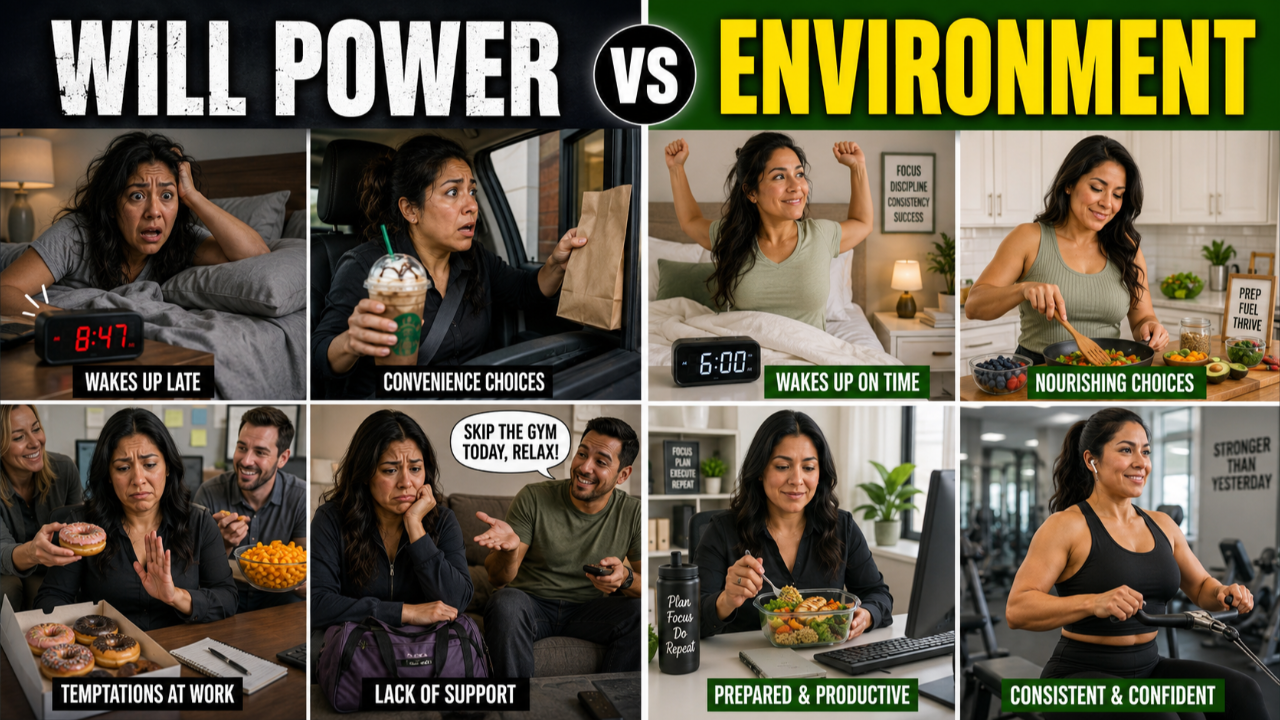
Your Willpower Will Never Beat Your Environment
Jun 02, 2026Your Willpower Will Never Beat Your Environment
A lot of people believe weight loss comes down to willpower. They think if they wanted it bad enough, they would eat better, work out consistently, stop snacking at night, drink more water, plan their meals, go to bed earlier, and finally stick to the plan. But that way of thinking ignores one of the biggest forces shaping human behavior: environment.
Willpower matters, but willpower is limited. Your environment is constant. Willpower has to be activated in the moment, usually when you are already tired, stressed, hungry, emotional, busy, or overwhelmed. Your environment, on the other hand, is already working before you make the decision. It is present when you wake up, when you walk into the kitchen, when you come home from work, when you sit on the couch, when you open your phone, and when the people around you behave in ways that feel normal.
That is why the statement is true: your willpower will never beat your environment.
From a psychological standpoint, the brain is designed to save energy. It does not want to think deeply about every decision throughout the day. The brain likes familiar routines, repeated patterns, and easy choices because they require less mental effort. This is how habits are formed. A cue shows up, the brain recognizes the pattern, and it pushes you toward the behavior it already knows.
If the pantry is full of snacks, the cue is already there. If the couch, phone, and TV are your normal evening routine, the pattern is already built. If fast food is the easiest option after work, the brain does not have to solve the problem of dinner. It picks what is convenient. If sleeping in is your default, waking up early to work out becomes a daily negotiation before the day even begins.
This does not mean you are weak. It means your environment is making certain behaviors easier to repeat. Over time, the behavior that is easiest to repeat usually becomes the behavior you keep doing. That is why relying on motivation alone is such a poor long term strategy. Motivation can help you start, but your environment determines how much resistance you face while trying to continue.
Your environment is always making suggestions. Your phone suggests scrolling. Your pantry suggests snacking. Your bed suggests sleeping in. Your calendar suggests what matters. Your kitchen suggests what you will eat. Your social circle suggests what is normal. Your workplace suggests when you eat, how often you sit, how much stress you carry, and how much energy you have left at the end of the day.
This is why environment can feel like control. It does not have to force you to do anything. It only has to make one behavior easier and another behavior harder. If eating off plan is easy and eating structured meals requires effort, eventually eating off plan will win. If skipping workouts is easy and training requires you to figure it out every day, eventually skipping will win. If staying up late is normal and going to bed on time requires discipline every night, eventually sleep will suffer.
The environment does not have to defeat you in one dramatic moment. It can wear you down through repeated exposure, repeated temptation, repeated stress, repeated convenience, and repeated social pressure. That is why people can genuinely want to change and still keep falling back into the same habits. The desire is real, but the environment keeps pulling them toward the old pattern.
There is also a sociological side to this. Your environment is bigger than your house. It includes your family, friends, coworkers, schedule, responsibilities, culture, income, neighborhood, and the standards you are surrounded by every day. Human beings are social creatures. We adjust to what we see. We copy what is repeated. We normalize what the group accepts.
If everyone around you overeats, overeating starts to feel normal. If everyone around you skips workouts, skipping workouts starts to feel normal. If everyone around you complains but takes no action, staying stuck starts to feel normal. If everyone around you treats health like something to care about later, neglecting your health starts to feel normal.
That is the dangerous part. Environment does not only influence behavior. Over time, it shapes identity. People repeat a behavior long enough, then they start believing it is who they are. They say things like, “I am just not disciplined,” “I am not a morning person,” “I always fall off,” “My family just eats like this,” “I do not have time,” or “I cannot stay consistent.” But many of those statements are learned identities built inside repeated environments.
This matters deeply for weight loss because many people keep asking for more tips while living in an environment that defeats every tip they receive. They want better nutrition, but their kitchen supports the old version of them. They want consistency, but their schedule is built around chaos. They want to work out, but exercise is treated like something they will do only after everything else is handled. They want better health, but their daily routine keeps rewarding the same choices that created the problem.
This is why more information is rarely enough. Many people already know they should eat more protein, track their food, drink more water, lift weights, move more, and get better sleep. The issue is that their environment does not make those behaviors easier to repeat. Knowing what to do does not matter much when the structure of your life keeps pulling you in the opposite direction.
A better approach is to stop trying to win every day through discipline alone and start designing an environment that supports the outcome you say you want. That means making the better choice easier, more visible, more convenient, and more normal. It also means making the old choice harder, less available, less automatic, and less rewarding.
This can look simple, but simple does not mean ineffective. Workout clothes can be laid out before bed. Meals can be planned before hunger hits. Protein can be prepared ahead of time. Trigger foods can be kept out of the house or placed where they are less visible. Your calendar can include scheduled workout times instead of hoping exercise magically fits into the day. Your family can be told what you are working on so your standards are clear. Your meals can be structured so you are not making every food decision from scratch.
The goal is to reduce how often you have to negotiate with yourself. Every time you have to decide whether to work out, whether to track your food, whether to cook, whether to stop eating, whether to go to bed, or whether to stay on plan, you are spending mental energy. When life is already stressful, that mental energy runs out fast. Structure protects you from needing to be strong every moment of the day.
This is also why support matters. A strong coaching environment, a clear plan, regular accountability, honest feedback, and practical structure can help replace an environment that keeps you stuck. The point of coaching is not just to tell you what to do. The point is to help you build the standards, systems, and routines that make doing it more realistic in your actual life.
Willpower can help you make a good decision once. Environment helps you make that decision repeatedly. Willpower can push you through a hard moment. Environment determines how many hard moments you have to fight each day. Willpower can help you start, but environment helps you continue.
So the goal is not to become a person with unlimited discipline. The goal is to build a life where discipline is required less often because the better choice has become the easier choice, the normal choice, and eventually the automatic choice.
That is how real lifestyle change happens. Not by hoping you feel motivated every day, but by building an environment that makes the person you want to become harder to avoid.
God Bless. Let's Work.
