

Why Sustainable Weight Loss Requires an Identity Shift, Not More Motivation
Jan 05, 2026Most people believe weight loss fails because they lack motivation, discipline, or the right information.
From a psychological and physiological standpoint, that explanation does not hold up.
Research in behavioral psychology and neurobiology shows that long-term behavior change does not come from motivation or goals. It comes from identity formation and environmental systems that reduce decision-making.
This is why people can lose weight repeatedly and still regain it. The behavior changes temporarily, but the identity does not.
Sustainable weight loss occurs when behaviors are no longer something you are forcing yourself to do, but something your brain recognizes as normal and expected.
That shift happens at the identity and systems level, not the motivation level.
1. Why Time-Based Goals Undermine Long-Term Weight Loss
From a psychological perspective, event-based goals create what researchers call temporal discounting.
When a goal has an end date, the brain treats behaviors as temporary sacrifices rather than permanent adaptations. This increases tolerance for extreme restriction because the discomfort feels short-lived.
“I can suffer now because relief is coming.”
This framing activates stress responses, increases cortisol, and heightens food preoccupation, which research shows increases binge risk and rebound eating once the deadline passes.
Identity-based goals remove the expiration date.
When the question shifts from “How fast can I lose this weight?” to “What behaviors can I repeat for years without burnout?” the nervous system calms. The brain stops scanning for an exit. Behaviors become less extreme and more repeatable.
If a behavior only works because a deadline exists, it is neurologically coded as temporary. Temporary behaviors do not become habits.

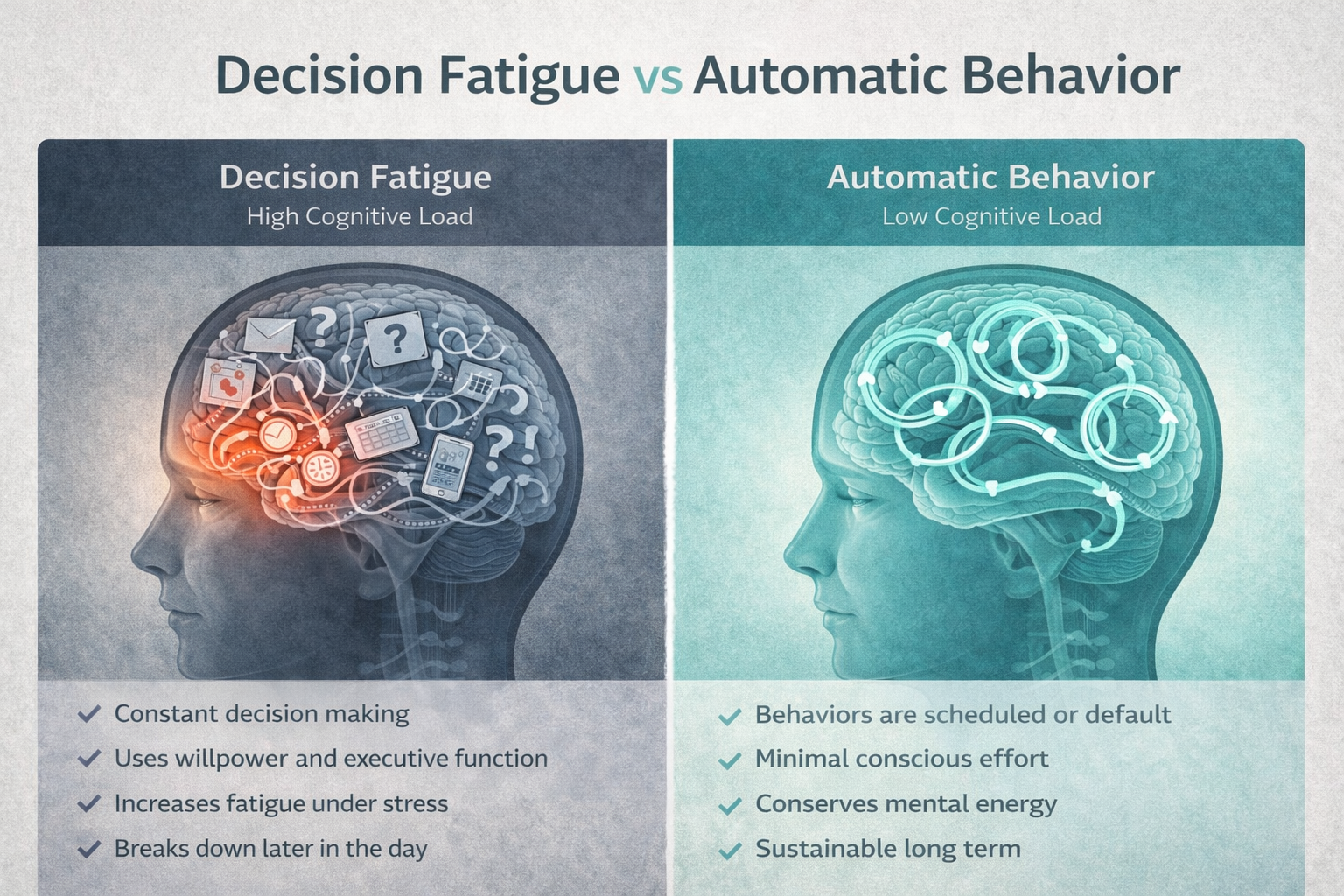
2. Decision Fatigue and the Cost of Daily Negotiation
One of the most overlooked psychological barriers to weight loss is decision fatigue.
Every time you ask:
-
“Do I feel like tracking today?”
-
“Do I feel like working out this week?”
...you are spending cognitive energy. Studies show that repeated decision-making reduces self-control over time, especially under stress. This is why people do well early in the day and struggle at night.
People who maintain weight long-term remove negotiation.
Tracking is not debated. Training is scheduled. Eating structure exists regardless of mood. This reduces cognitive load and shifts behaviors from the prefrontal cortex (effort) to automatic processing (habit).
Identity is formed when behaviors move from effortful to expected.
3. Systems Beat Motivation at the Neurobiological Level
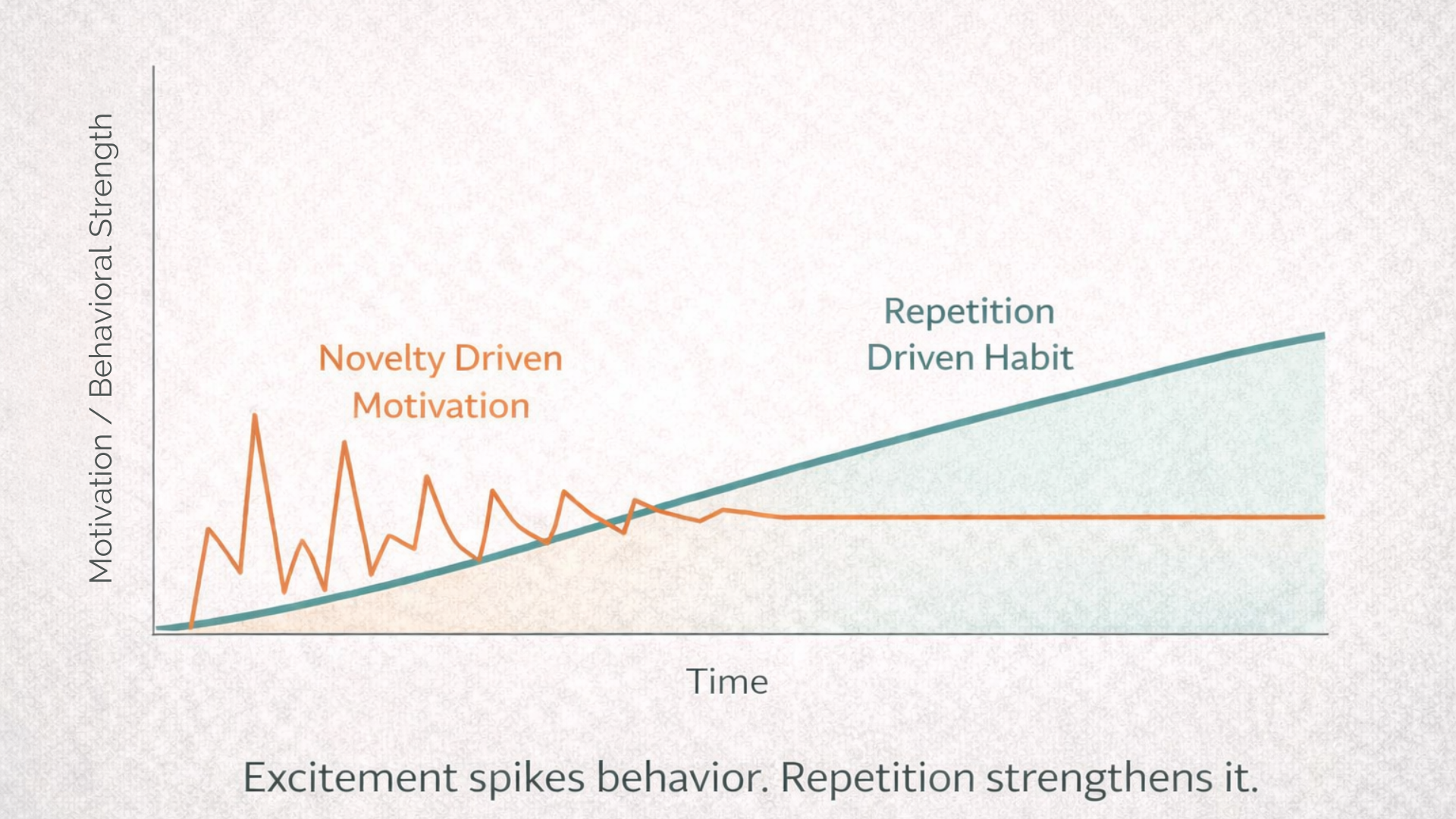
Motivation is an unreliable driver of behavior because it is tied to dopamine spikes. Dopamine increases with novelty, excitement, and urgency, then drops once the stimulus becomes familiar.
Sustainable systems are intentionally boring.
-
Repetitive meals reduce decision-making.
-
Scheduled training removes emotional dependency.
-
Consistent tracking builds awareness without drama.
From a neurological standpoint, repetition under stable conditions strengthens neural pathways.
When systems hold during stress, travel, fatigue, and boredom, the brain updates its self-image: “This is just what I do.”
That is identity consolidation.
4. Emotional Detachment and Self-Regulation
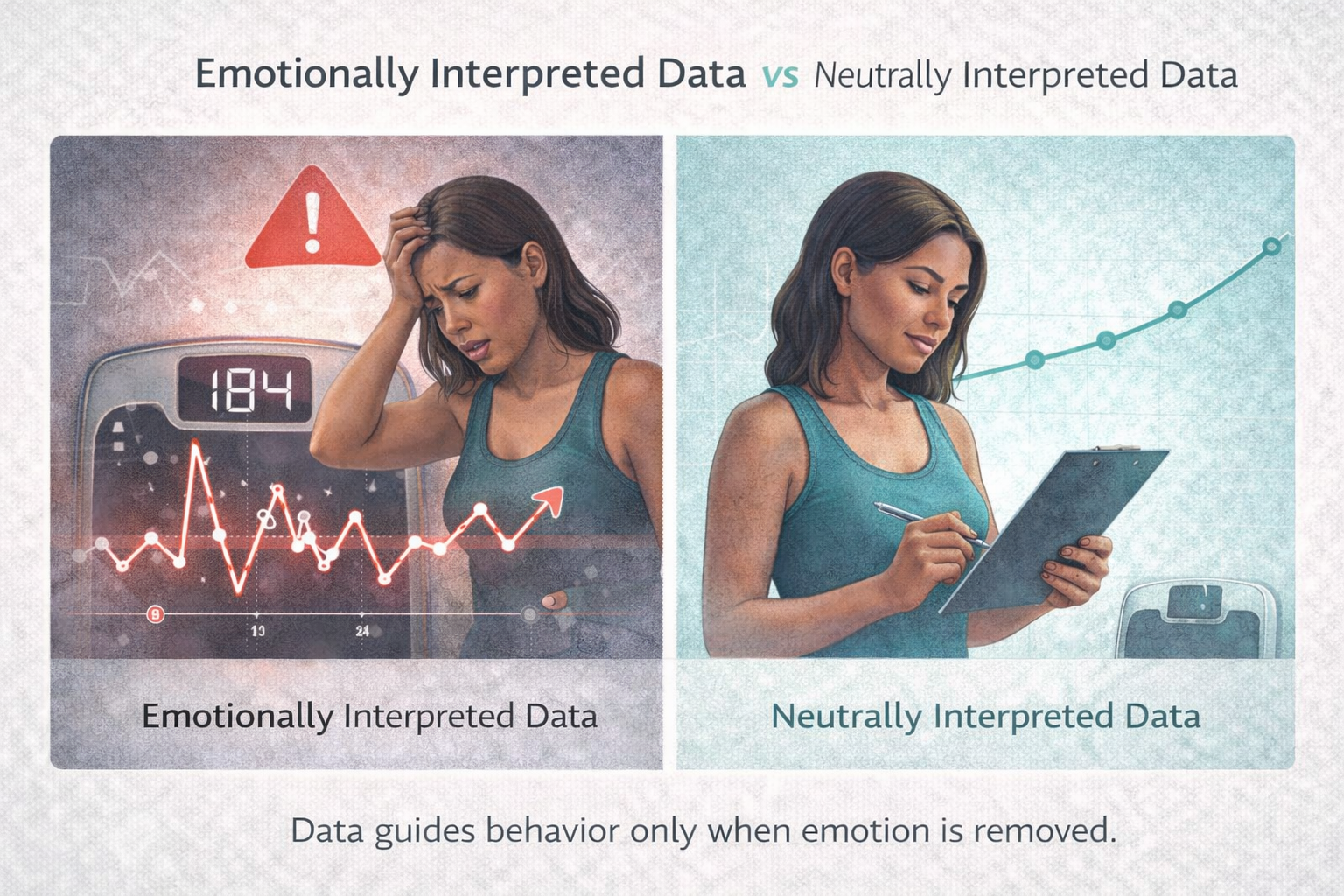
Event-focused weight loss creates emotional volatility. The scale becomes a reward or punishment. Fluctuations trigger restriction or abandonment. Missed workouts are interpreted as failure.
This emotional coupling increases stress hormones and impairs self-regulation.
Identity-focused individuals use data neutrally.
Weight is information. Missed sessions are feedback. Progress is assessed over trends, not moments. This emotional neutrality supports better executive function and long-term consistency.
Without emotional regulation, identity cannot stabilize.
5. Identity-Based Framing and Self-Perception Theory
According to Self-Perception Theory, people infer who they are by observing what they consistently do.
Not what they intend. Not what they plan. What they repeat.
When behaviors are consistent regardless of mood or outcome, the brain updates identity.
-
“I am someone who tracks.”
-
“I am someone who trains.”
-
“I am someone who maintains structure.”
At that point, the question stops being “Is this working?” and becomes “Is this how I live?”
When behavior and identity align, results follow without force. When identity is solid, results stop being fragile.
The Bottom Line
Sustainable weight loss is not about wanting it more.
It is about reducing cognitive load, stabilizing behavior, regulating emotion, and allowing identity to catch up to action.
When urgency is removed, negotiation is eliminated, and systems replace motivation, weight loss stops being something you chase and becomes a byproduct of who you are.
How We Help You Create This Shift
If you want to experience this identity shift instead of just reading about it, there are two ways to work with us.
The 21 Day Reset Designed to help you break the cycle of event-based weight loss and build structure, awareness, and consistency. It is the entry point for learning how to eat, train, and think like someone who keeps the weight off.
CLICK HERE TO JOIN
1-on-1 Coaching If you are ready for deeper structure, personalization, and accountability, this is where identity-level change is built long-term. This is for individuals who are done starting over and want systems that survive real life.
CLICK HERE TO APPLY
If you are ready to stop chasing results and start becoming the person who maintains them, choose the path that matches your level of commitment.
God bless. Let’s work.
References
Baumeister, R. F., Bratslavsky, E., Muraven, M., & Tice, D. M. (1998).
Ego depletion, is the active self a limited resource? Journal of Personality and Social Psychology, 74(5), 1252–1265.
Supports: decision fatigue, reduced self control with repeated decisions.
Baumeister, R. F., & Tierney, J. (2011).
Willpower: Rediscovering the greatest human strength. New York, NY: Penguin Press.
Supports: negotiation, cognitive load, why removing decisions improves consistency.
Berridge, K. C., & Robinson, T. E. (1998).
What is the role of dopamine in reward? Hedonic impact, reward learning, or incentive salience? Brain Research Reviews, 28(3), 309–369.
Supports: dopamine spikes, novelty, motivation decline.
Bouton, M. E. (2004).
Context and behavioral processes in extinction. Learning & Memory, 11(5), 485–494.
Supports: why behaviors tied to specific contexts or time frames fail to persist.
Duhigg, C. (2012).
The power of habit: Why we do what we do in life and business. New York, NY: Random House.
Supports: habit loops, repetition, predictability over motivation.
Herman, C. P., & Polivy, J. (1980).
Restrained eating. In A. J. Stunkard (Ed.), Obesity (pp. 208–225). Philadelphia, PA: Saunders.
Supports: restriction, rebound eating, binge risk after dieting.
Loewenstein, G., & Thaler, R. H. (1989).
Anomalies: Intertemporal choice. Journal of Economic Perspectives, 3(4), 181–193.
Supports: temporal discounting, short term sacrifice framing.
Muraven, M., & Baumeister, R. F. (2000).
Self regulation and depletion of limited resources. Journal of Personality and Social Psychology, 82(2), 247–259.
Supports: why willpower degrades under stress and repeated effort.
Ouellette, J. A., & Wood, W. (1998).
Habit and intention in everyday life. Psychological Bulletin, 124(1), 54–74.
Supports: identity, habits overriding intention.
Polivy, J., & Herman, C. P. (2002).
If at first you don’t succeed: False hopes of self change. American Psychologist, 57(9), 677–689.
Supports: repeated failed dieting cycles and identity mismatch.
Quinn, J. M., Pascoe, A., Wood, W., & Neal, D. T. (2010).
Can’t control yourself? Monitor those bad habits. Personality and Social Psychology Bulletin, 36(4), 499–511.
Supports: automatic behavior over conscious control.
Bem, D. J. (1972).
Self perception theory. In L. Berkowitz (Ed.), Advances in Experimental Social Psychology (Vol. 6, pp. 1–62). New York, NY: Academic Press.
Supports: identity formation through repeated behavior.
