
The Psychology of Weight Loss: Thoughts, Behavior, and Results
Apr 21, 2026The Psychology of Weight Loss: Thoughts, Behavior, and Results
Most people don’t struggle with weight loss because they lack information.
They struggle because they are operating on expectations that have nothing to do with how the body actually works.
You see it all the time.
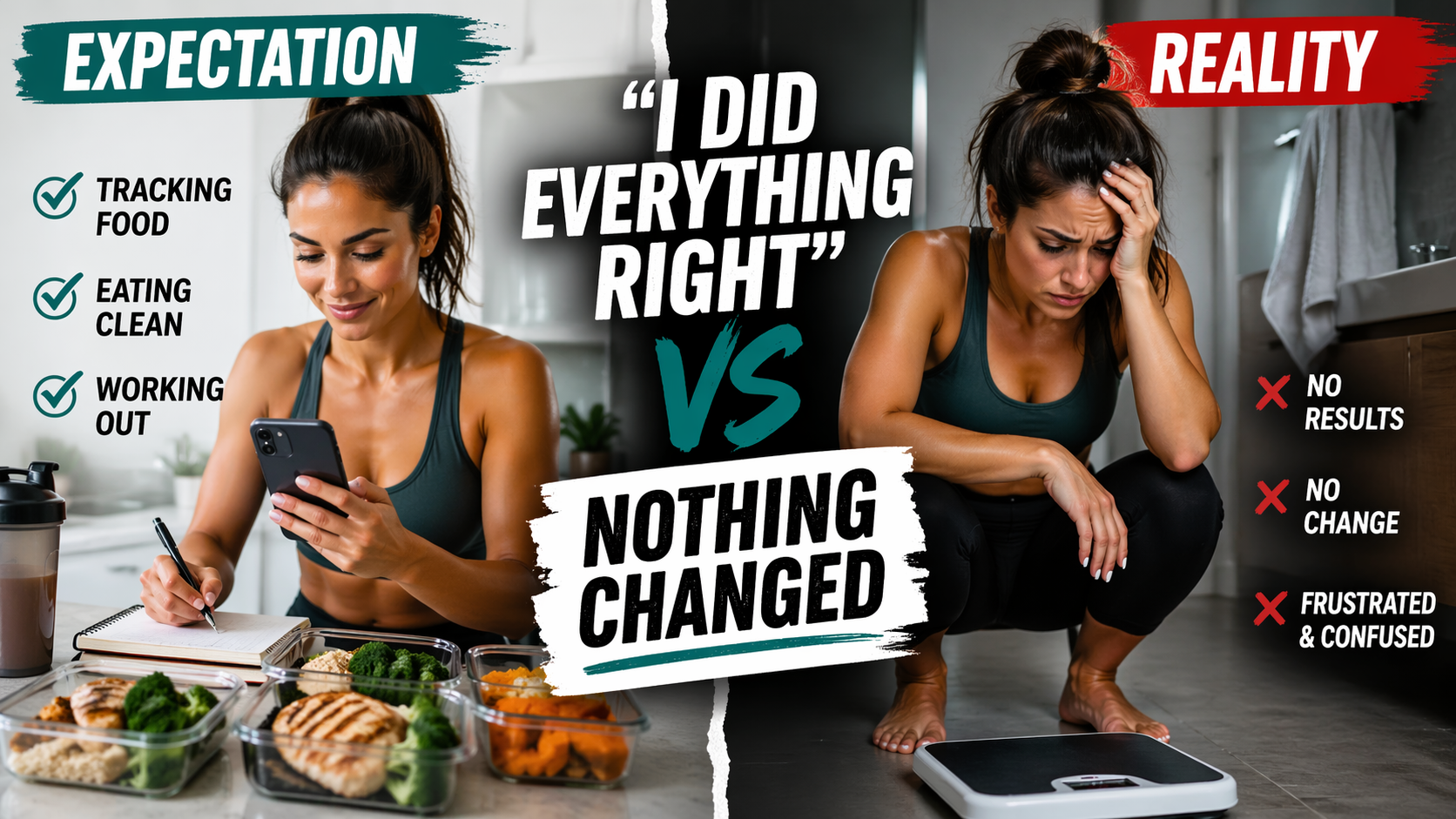
Someone tracks their food for a few days and expects the scale to move immediately.
Someone starts working out and expects visible changes within a couple of weeks.
When that doesn’t happen, the reaction is almost automatic:
“This should be working.”
That one sentence tells you everything you need to know.
Because the moment “should” enters the conversation, the process has already shifted from objective to emotional.
The Problem Isn’t Effort. It’s Interpretation.
Most people are not lazy.
They are misinterpreting what their effort means.
Tracking your food does not guarantee weight loss.
Working out does not guarantee visible change.
Those actions only matter if they are done accurately, consistently, and long enough to create a measurable effect.
But instead of asking:
“Is this working based on data?”
People ask:
“Why isn’t this working based on how I feel?”
That is where the breakdown begins.
Because the body does not respond to effort, intention, or frustration.
It responds to consistent conditions over time.
The “Should” Trap in Action
The word “should” is not just a word. It is a signal.
It tells you that someone has created a rule in their head about how progress is supposed to look.
- “I worked out all week, I should be seeing something”
- “I ate better today, I should be down tomorrow”
These expectations feel reasonable.
But they are not grounded in physiology.
They are grounded in impatience and comparison.
When reality doesn’t match those expectations, the response is frustration. And frustration rarely leads to better decisions.
It usually leads to one of two outcomes:
People either tighten everything up too aggressively, or they give up completely.
Both lead to the same result, inconsistency.
Why Thoughts Matter More Than Plans
Every plan works on paper.
A calorie deficit works.
Strength training works.
Tracking works.
But none of those matter if the person following the plan is constantly negotiating with themselves.
Because every decision starts before the action.
It starts with a thought.
“I’ll just start tomorrow.”
“This one thing won’t matter.”
“I already messed up, I’ll restart Monday.”
These are not random thoughts.
They are patterns.
And once those patterns are in place, behavior becomes predictable.
This is exactly what Cognitive Behavioral Therapy explains. Thoughts influence emotions, emotions influence behavior, and behavior produces results.
If the thoughts are inconsistent, the behavior will be inconsistent.
And no plan survives inconsistent execution.
The Pattern Is the Problem
When someone says they “can’t lose weight,” what they are really saying is:
“I can’t maintain the behaviors required long enough to see results.”
That is a pattern problem.
You can see it clearly when you zoom out:
They start strong.
They tighten everything up.
They expect fast results.
They don’t see them.
They get frustrated.
They fall off.
Then they repeat the cycle.
This is where Self-Fulfilling Prophecy shows up in real time.
If someone believes they always fall off, they start expecting it.
If they expect it, they behave in ways that lead to it.
When it happens, it confirms what they already believed.
Now the pattern feels permanent.
Not because it is, but because it has been repeated enough times to feel true.
Why Emotion Overrides Logic
Weight loss is often explained as a logical process.
Eat less, move more.
That is true.
But it ignores how people actually make decisions.
No one overeats because they did bad math.
They overeat because they are stressed, tired, bored, or frustrated.
This is tied to Emotional Conditioning.
Over time, food becomes associated with relief.
Stress leads to eating.
Boredom leads to eating.
Fatigue lowers resistance.
So even if someone knows exactly what to do, their behavior shifts based on how they feel in the moment.
If their system only works when they feel motivated, it is not a system.
It is a temporary state.
The Identity Layer Most People Ignore
At some point, this stops being about food entirely.
It becomes about identity.
Someone who believes:
“I’m inconsistent”
Will behave inconsistently, even if they have the perfect plan.
Someone who believes:
“I always quit”
Will eventually quit, even after making progress.
Because behavior always aligns with identity.
This is what Self-Concept is built on.
People act in ways that reinforce who they believe they are.
Which means even success can feel uncomfortable if it doesn’t match that identity.
And when something feels off, people tend to return to what feels familiar, even if it is not what they want.
Why Calories Alone Don’t Solve This
Calories determine whether weight is lost or gained.
That part is not up for debate.
But calories do not determine whether someone follows through.
Psychology does.
You can give someone the exact numbers they need.
You can give them the exact plan.
But if their thinking leads to inconsistent behavior, the outcome will not change.
This is why people feel like they have “tried everything.”
They have tried many different approaches.
They have not changed the pattern driving their behavior.
What Actually Needs to Change
The shift is not complicated, but it requires honesty.
Instead of asking:
“Why isn’t this working?”
The better question is:
“What am I actually doing consistently?”
That means stepping away from how things feel and looking at what is real.
Are calories being tracked accurately, or estimated?
Is the deficit consistent, or does it fluctuate?
Has enough time passed to see a trend, or are you reacting day to day?
Progress is not judged in moments.
It is judged in patterns.
What Comes Next
Understanding this is the first step.
Because once you see that your results follow patterns, you stop chasing quick fixes and start looking at what is actually driving your behavior.
Next, we are going deeper.
We are going to break down where these thought patterns come from, how they are formed early, and why they feel automatic.
After that, we will show you how to reframe them and replace them with patterns that support consistency instead of working against it.
Because once you understand the pattern, you can take control of it.
Ready to do this the right way?
The 21 Day Reset
The 21 Day Reset is designed to stop the crash dieting cycle and teach you how to set up fat loss correctly.
Inside the Reset, you will:
-
Learn how to structure your eating
-
Build strength training consistency
-
Create momentum without burnout
-
Lay the foundation for long-term fat loss
This is the best place to start if you want clarity, structure, and early visible results.
👉Join The Next 21-Day Rest
1 on 1 Coaching
If you want:
-
A personalized fat loss strategy
-
Weekly adjustments based on real data
-
Accountability that prevents self-sabotage
-
Results that actually last
Then, 1-on-1 coaching is the fastest and safest way to lose 20 pounds of body fat and keep it off.
👉Apply For Coaching
God Bless. Let's Work.
