
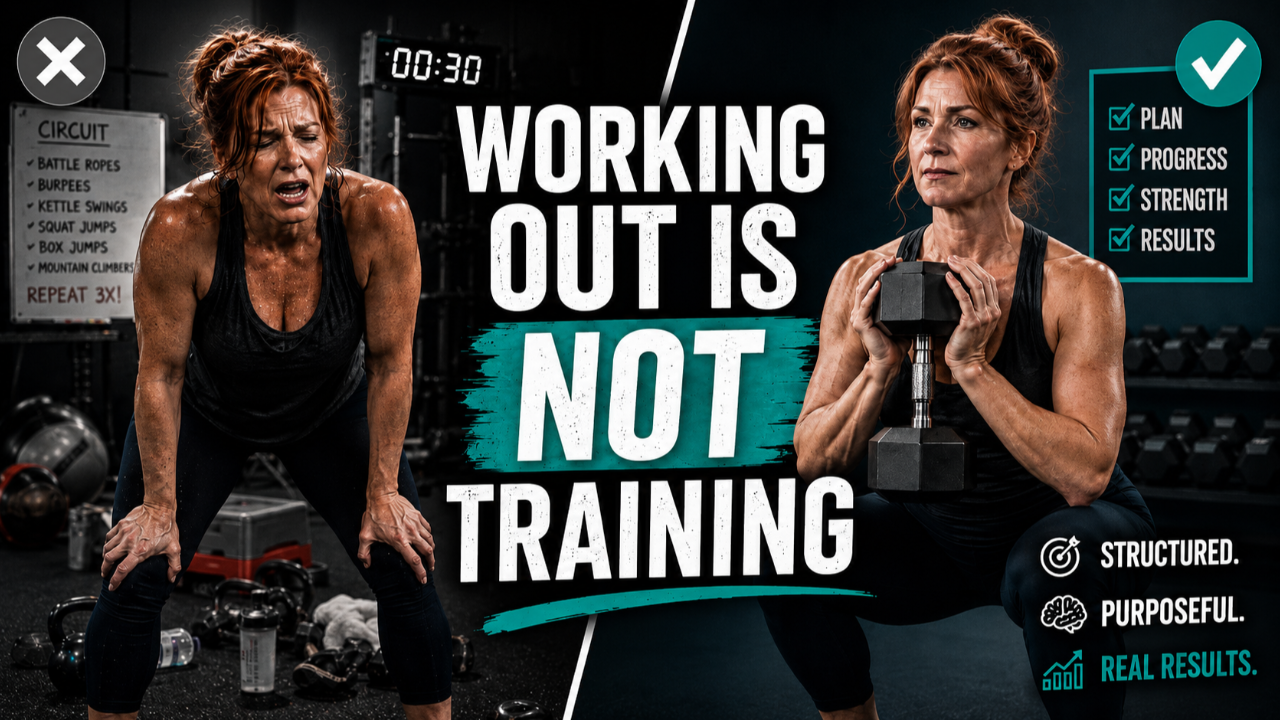
The Training Lies Women Keep Getting Told
Jun 17, 2026For years, women have been taught to judge fitness by the wrong standards.
They have been told to measure success by how much they sweat, how sore they feel the next day, how many calories their watch says they burned, or how exhausted they are when the session is over.
The problem is that none of those things automatically mean the plan is working.
A hard session is not always an effective one. A routine can feel intense and still fail to build muscle, improve strength, teach proper movement, or create the body a woman actually wants. This is where many women get frustrated. They are putting in effort, but that effort is not being directed through a real system.
The issue is not simply whether a person exercises. The bigger question is whether they are training in a way that creates adaptation.
If the goal is to lose body fat, build shape, improve strength, and maintain results for life, then the plan has to do more than make you tired. It has to make you better.
That starts with understanding the difference between exercising and training.
Exercising Is Not the Same as Training
Exercise is physical activity.
Training is a structured process designed to create a specific result.
There is nothing wrong with being active. Walking, hiking, dancing, classes, recreational sports, and general movement all have value. The problem starts when activity gets mistaken for a complete plan.
A person can move often and still lack strength. She can attend classes for years and still struggle with basic form. She can burn calories every week and still fail to build the muscle, control, and confidence needed for long-term change.
Training has direction. It has standards. It has progression. It gives the body a reason to improve.
Go into almost any gym in the world and pay attention to the people who are the fittest, strongest, and healthiest. Most of them are not doing the most complicated routines. They usually have simple plans they repeat consistently.
They squat. They hinge. They press. They row. They lunge. They train their core. They walk. They recover. Then they come back and improve.
More control.
More weight.
More reps.
Better execution.
That may not be flashy, but it works.
The people who get the best results are usually not the ones chasing every new exercise online. They are the ones who understand the basics and repeat them long enough to master them.
That is where many of the training lies told to women become a problem.
Lie 1: Light Weights and High Reps Are How You Tone
This is one of the most common myths women hear.
The message is usually simple: heavy weights make you bulky, light weights make you lean.
That is not how the body works.
“Toning” is not a special type of exercise. It is the result of building enough muscle to create shape while reducing enough body fat to see that shape.
Muscle gives the body its structure. Fat loss reveals it.
This is why using weights that never challenge the muscle becomes a problem. A woman can do endless reps with light dumbbells, feel a burn, and still not create enough stimulus for real change.
The burn is not the goal. Challenge is.
That does not mean every woman needs to lift recklessly, max out, or train like a powerlifter. It means the muscle has to be pushed beyond what it is already comfortable doing. Over time, that can happen through heavier weight, better control, more reps, improved range of motion, stronger contractions, or cleaner technique.
Light weights can build muscle when they are used with enough effort. The issue is that many women stop far before the set becomes truly challenging. They move, they sweat, they feel something, but they are not asking the body to adapt.
If the resistance never demands more from you, your body has no reason to give you more in return.
A defined body is not built by avoiding challenge. It is built by creating the right one.
Lie 2: Sweat Means the Workout Worked
Sweat is one of the most overrated measurements in fitness.
A lot of people finish a session and immediately judge it by how wet their shirt is. If they are drenched, they believe it was productive. If not, they assume it was not enough.
That is a poor standard.
Sweat is your body’s cooling system. You can sweat because the room is hot, because the humidity is high, because you are moving fast, because you are wearing extra layers, or because your body temperature rises.
None of that proves you built muscle, improved form, gained strength, or lost body fat.
You can sweat in a sauna. You can sweat walking outside in the summer. You can sweat through a poorly designed circuit that has no clear purpose.
Instead of asking, “Did I sweat?” ask better questions.
Did I train the muscles I intended to train?
Did I use enough resistance?
Did I control the movement?
Did my form improve?
Did I progress from last week?
Does this fit into a larger plan?
Those are the questions that matter.
Sweat may happen during quality training, but it should never be the standard. The standard is improvement.
Lie 3: You Need to Confuse Your Muscles
Your muscles do not need confusion.
They need a clear signal.
The idea of “muscle confusion” sounds exciting because it makes variety feel productive. This is why complicated routines, exercise mashups, and fast-paced circuits do so well online. They look interesting. They feel different. They create the impression that something advanced is happening.
But different is not always better.
If every session changes completely, it becomes difficult to measure progress. You cannot know whether your squat improved if you rarely squat the same way. You cannot know whether your back is getting stronger if the exercises keep changing. You cannot build skill in movements you never practice long enough to master.
A better body is not built by constantly starting over.
It is built by improving the movements that matter.
Squats. Hinges. Presses. Rows. Lunges. Pulldowns. Carries. Core work. Isolation movements done with purpose.
These are not boring exercises. They are foundational. The reason they show up in quality programs over and over again is because they work.
The strongest and healthiest people in the gym usually understand this. They are not trying to entertain their muscles. They are developing them.
That requires repetition, progression, focus, and patience.
Random effort creates random outcomes. Structured training creates measurable progress.
Lie 4: The Fat-Burning Zone Is Best for Fat Loss
The fat-burning zone is one of the most misunderstood ideas in exercise.
At lower intensities, the body may use a higher percentage of fat for fuel during the session. That part is true. The mistake is thinking that burning a higher percentage of fat during exercise automatically means more body fat is lost over time.
Those are two different things.
Fat loss comes down to overall energy balance. If a woman is not in a calorie deficit consistently, staying in the fat-burning zone will not produce meaningful fat loss by itself.
This is where many people get misled. They walk on the treadmill, hold the handles, keep the pace comfortable, and trust the machine because it says they are burning fat.
But the body does not operate based on a treadmill label.
Low-intensity cardio can be useful. Walking matters. Steps matter. Steady-state work can support heart health, recovery, and daily calorie expenditure. It can absolutely be part of a successful fat loss plan.
The problem is treating it like the entire plan.
Nutrition still matters. Resistance training still matters. Daily movement still matters. Sleep, recovery, and consistency still matter.
The goal is not to obsess over which fuel source is being used during one session. The goal is to create the conditions that allow body fat to decrease over weeks and months while preserving muscle.
The fat-burning zone is a tool.
It is not a complete system.
Lie 5: You Have to Be Sore After Every Workout
Soreness is not proof of progress.
It usually happens when the body experiences something new, unfamiliar, excessive, or more demanding than what it is used to. It can follow a productive session, but it can also come from poor programming, too much volume, bad pacing, or movements the body was not ready for.
Being sore does not mean you built more muscle.
It does not mean you burned more fat.
It does not mean the plan is better.
Constantly chasing soreness can actually hold a woman back. When recovery is always poor, performance drops. Form gets worse. Motivation fades. Eventually, training starts to feel like punishment instead of development.
The goal is not to destroy your body.
The goal is to apply enough stress to create adaptation, recover well, and come back prepared to improve.
Some soreness is normal, especially when starting a new phase or returning after time off. But it should not be the main measurement.
Progress is the measurement.
Can you lift more?
Can you perform more reps with good form?
Can you control the movement better?
Can you recover and stay consistent?
Those are better indicators than pain.
A good plan should challenge you without constantly breaking you down.
Why the Basics Matter More Than the Fancy Stuff
The basics reveal the truth.
A push-up shows upper body strength, core control, shoulder stability, body awareness, and the ability to create tension from head to toe.
A squat shows mobility, balance, coordination, lower body strength, and movement quality.
A sit-up shows trunk strength, control, and the ability to move without relying on momentum or assistance.
These movements may seem simple, but simple does not mean easy.
Many women skip past the foundation because they want more variety, more intensity, or more advanced exercises. But if the foundation is weak, advanced work only exposes the problem. It does not automatically correct it.
This is why someone can survive a hard class and still lack basic strength.
She can complete a circuit but struggle to control her body.
She can do countless exercises but never master the patterns that matter most.
Push-ups, squats, hinges, rows, presses, lunges, carries, and core control are not just beginner movements. They are the base of long-term fitness.
When those patterns improve, everything else improves with them.
What Proper Training Should Actually Do
A real plan should do more than burn calories.
It should build strength, improve movement, increase muscle definition, preserve lean tissue during fat loss, and make the body more capable over time.
It should also give you a way to measure progress.
That is the part many women are missing. They have exercises, but no standards. They have effort, but no direction. They are working hard without knowing whether the work is leading anywhere.
Proper training gives you feedback.
Your form should improve.
Your strength should improve.
Your control should improve.
Your confidence should improve.
Over time, your body should become more capable both inside and outside the gym.
That is the real value of training. It is not just about what happens during one session. It is about the body you are building for the next 10, 20, and 30 years.
The Questions Women Should Ask About Their Workouts
Most women have been taught to ask the wrong questions.
Instead of focusing on sweat, soreness, calorie burn, difficulty, or variety, ask questions that reveal whether your plan is actually working.
Am I getting stronger?
Is my form improving?
Do I have better control over my body?
Is there progression in this plan?
Can I repeat this consistently?
Is this helping me build the body I actually want?
Those questions change the standard.
You stop being impressed by routines that only make you tired. You stop chasing pain as proof. You stop letting a fitness watch decide whether the session mattered.
You start paying attention to strength, skill, consistency, recovery, and results.
That is the shift many women need.
The Fitness Test Tells the Truth
Whenever I start working with a new client, one of the first things I do is give her a basic fitness test.
Push-ups.
Sit-ups.
Bodyweight squats.
Nothing fancy. Nothing extreme. Just the basics.
And here is what I see over and over again: 99 percent of the women who attempt the test cannot perform full push-ups from their toes, cannot do a sit-up without anchoring their feet, and struggle to squat with clean form.
These are not always beginners.
Many have worked with personal trainers before. Some have spent years in gyms, bootcamps, classes, and online programs. Some have even been trainers themselves.
That is the point.
You can be active for years and still not be training properly.
You can put in effort and still lack basic strength.
You can complete hard sessions and still struggle with fundamental movement.
This is why bad advice is not harmless. When a woman builds her routine around exhaustion, soreness, variety, and calorie burn without developing strength, control, coordination, and proper technique, she is setting herself up for long-term frustration.
This is not about shame. It is about awareness.
Your body will tell the truth if you are willing to test it.
The Self-Test Challenge
I encourage you to test yourself.
How many full push-ups can you do from your toes?
How many sit-ups can you do without anchoring your feet?
How many bodyweight squats can you perform with clean, controlled form?
Do not rush the test. Do not cheat the reps. Do not turn it into an ego check.
Use it as information.
If you struggle with these movements, that does not mean you failed. It means you found the area that needs attention.
The answer is not more complicated exercises.
The answer is better training.
Because if you struggle with the basics, you will struggle with what is built on top of them.
Stop Training for the Feeling and Start Training for the Result
Women do not need more fitness noise.
They need structure, progression, strength, skill, and a system that teaches them how to train properly.
The body changes when training has purpose. If your current approach is not making you stronger, improving your movement, building muscle, supporting fat loss, or making you more capable over time, it is time to stop judging it by how it feels and start judging it by what it produces.
Hard sessions are easy to create.
Effective training requires a plan.
The Get Lifted System
Inside the Get Lifted system, we teach women how to stop guessing and start training with structure, purpose, and progression.
We do not just give you exercises to complete. We teach you how to move, how to progress, and how to understand what actually creates results.
When you know how to train properly, you stop chasing random routines and start building a body that is stronger, leaner, more defined, and more capable.
If you are tired of putting in effort without seeing the result you want, it is time to stop guessing.
It is time to train with a system.
Click Here To Learn More
God Bless.
Let’s work.
Coach Dom
