
Every Calorie Matters: Why Eating Healthy Is Not Enough for Weight Loss
Jun 16, 2026
There is a specific kind of frustration that happens when someone feels like they are doing everything right, but their body is not changing.
They are not eating fast food every day. They are not drinking soda all day. They are not sitting around doing nothing. In fact, they may be making better choices than they have made in years. They are buying healthier groceries, cooking more meals at home, drinking more water, walking more, choosing salads, cutting back on sweets, and trying to be more disciplined.
Then they step on the scale, and nothing has changed.
Or worse, the scale has gone up.
That moment can feel defeating because it creates a painful question: “If I am eating better, why am I not losing weight?”
This is where many people begin to believe something is wrong with their body. They assume their metabolism is slow, their hormones are stopping them, their age is working against them, or that weight loss simply does not work for them anymore.
While hormones, age, stress, sleep, medications, and health conditions can influence the difficulty of the process, they do not remove the need to understand the basic function of food, energy, and body change.
The problem is often not that the person is failing. The problem is that they were never taught how food actually works.
Most people were taught to think about food in overly simple categories: good foods and bad foods, clean foods and junk foods, healthy foods and unhealthy foods. That way of thinking may help someone improve food quality, but it does not automatically teach them how to lose body fat.
For weight loss, the conversation has to become more precise.
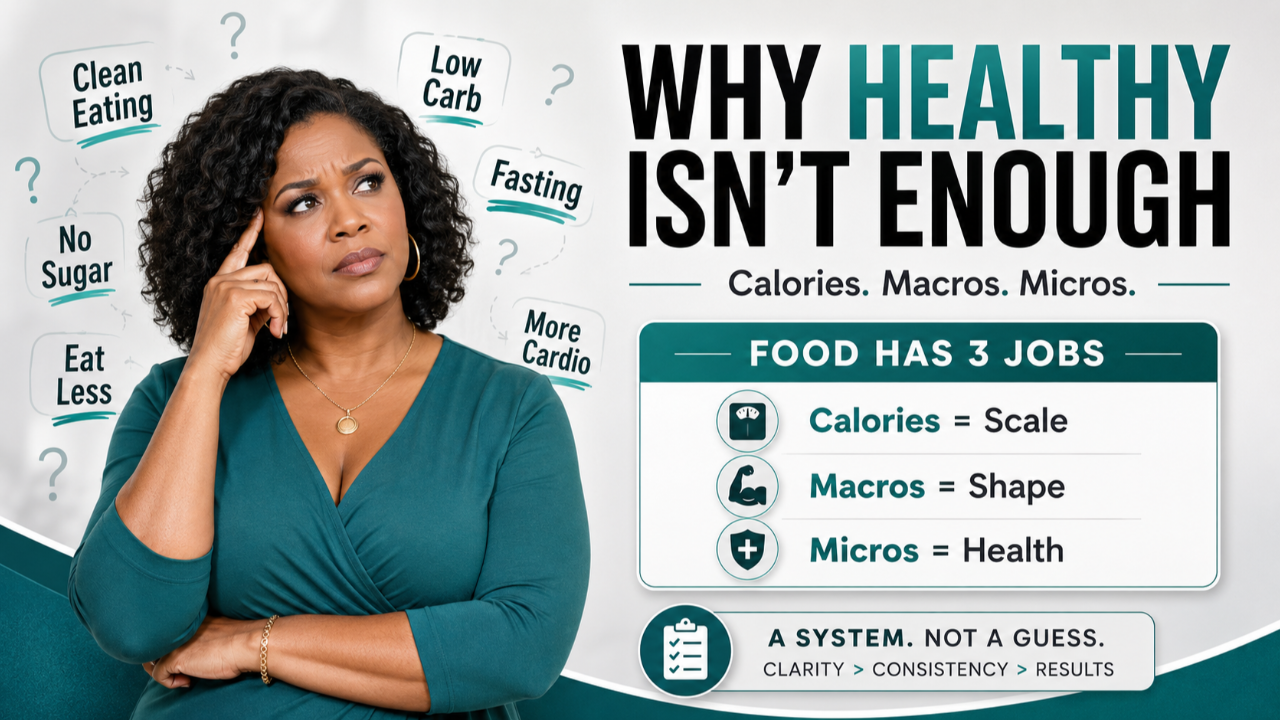
Calories determine the weight on the scale.
Macronutrients greatly influence body composition, meaning how the body looks as weight changes.
Micronutrients influence health, hormones, energy, cravings, digestion, mood, and how someone feels on a daily basis.
All three matter, but they do not all do the same job.
That distinction is where everything starts to make more sense.
Eating Healthy Does Not Automatically Mean Eating Less
One of the most common mistakes in weight loss is assuming that healthier eating automatically creates fat loss.
A client may tell me, “Coach, I do not understand. I have been eating clean all week.”
When we look closer, the foods may genuinely be healthier. Breakfast may be oatmeal with peanut butter, fruit, and honey. Lunch may be a salad with grilled chicken, avocado, cheese, nuts, dressing, and a side of fruit. Dinner may be salmon, rice, vegetables, and olive oil. Snacks may include protein bars, trail mix, smoothies, or Greek yogurt with granola.
None of those foods are bad. Many of them are nutrient-dense and can absolutely fit into a fat loss system.
The issue is that healthy foods still contain calories.
A salad can be full of vitamins, minerals, fiber, and protein, while also becoming a high-calorie meal once you add dressing, cheese, nuts, avocado, dried fruit, croutons, and oil. A smoothie can include fruit, protein powder, almond butter, oats, and healthy seeds, while quietly turning into several hundred calories. Olive oil may be heart-healthy, but pouring it freely into a pan does not make the calories disappear.
This is why “I am eating healthy” does not always answer the more important question: “Am I eating in a way that supports fat loss?”
Those are related questions, but they are not the same question.
Healthy eating can improve the quality of your diet. It can support blood sugar, digestion, energy, performance, and long-term health. However, if total calorie intake remains higher than what the body needs, fat loss will not consistently happen.
That is not punishment. That is physiology.
What Your Body Does With Food
Once food enters the body, your body is not concerned with whether that food was labeled clean, organic, low-carb, low-fat, natural, or approved by the internet.
Your body is dealing with energy, nutrients, and demand.
Every time you eat, some of that energy may be used immediately. Some may be stored in muscle and liver as glycogen. Some may support normal bodily functions, movement, recovery, repair, and training. If more energy is coming in than the body needs over time, the excess has to be stored.
That storage can show up as body fat.
This is why every calorie matters.
It does not mean every food is equal. A cookie and a piece of chicken do not have the same effect on hunger, fullness, protein intake, blood sugar, muscle retention, or cravings. They clearly serve different roles.
But both contain energy, and the body has to account for that energy.
A person can gain body fat eating mostly healthy foods if total caloric intake consistently exceeds what their body needs. A person can also lose weight while including foods others may call bad if total intake is controlled.
That does not make food quality irrelevant. It means food quality and calorie control are different parts of the same conversation.
Mature nutrition begins when a person stops asking, “Is this food good or bad?” and starts asking, “What role does this food play inside my goals?”
Calories Determine Scale Weight
If the goal is weight loss, calories are the primary driver of what happens on the scale over time.
That does not mean the scale will move perfectly every day. Body weight can fluctuate because of water retention, sodium intake, carbohydrate intake, digestion, stress, inflammation, menstrual cycle changes, soreness from training, and sleep quality. A person can be losing fat and still see the scale temporarily stall or jump.
However, over time, the body cannot consistently lose weight without being in an energy deficit.
This is why someone can eat very clean and still maintain or gain weight. If total intake is equal to maintenance, the scale will maintain. If total intake is above maintenance, the scale can move up. If total intake is consistently below what the body needs, the scale will trend down.
The scale is not responding to how hard someone feels like they are trying. It is responding to what the body is experiencing consistently over time.
That can be a hard truth, but it is also freeing, because if the body is responding to a process, then the process can be evaluated, improved, and adjusted.
Macros Influence How You Look
Weight loss and fat loss are not always the same thing.
A person can lose weight in a way that leaves them smaller, but softer. They can lose weight while losing muscle, feeling weak, looking flat, and struggling to maintain the results. This often happens when the focus is only on eating less, without enough attention to protein, strength training, and the overall structure of the diet.
This is where macronutrients matter.
Macronutrients are protein, carbohydrates, and fats. They all provide calories, but they serve different roles in the body.
Protein supports muscle repair, muscle retention, satiety, and recovery. For someone trying to lose fat while improving the shape of their body, protein is one of the key nutritional anchors.
Carbohydrates support training performance, energy, recovery, and daily function. They are not automatically fattening. In the right structure, they can help someone train harder, recover better, and maintain consistency.
Fats support hormones, cell function, health, and satiety. They are necessary, but because fats are calorie-dense, portions can add up quickly when there is no awareness.
This is why two people can lose the same amount of weight and look completely different at the end. One person may lose weight by under-eating, skipping meals, doing excessive cardio, and barely consuming protein. Another may lose weight while strength training, eating enough protein, managing calories, and maintaining performance.
The scale may show progress for both, but their bodies will not look the same.
Calories determine weight change.
Macros strongly influence the quality of that weight change.
That matters because most people do not just want to weigh less. They want to look better, feel stronger, move better, fit their clothes better, and feel more confident in their body.
That requires more than simply eating less.
Micros Influence How You Feel
Micronutrients are vitamins, minerals, fiber, and the many nutrients that support health and daily function. They do not get the same attention as calories and macros, but they matter deeply.
This is where food quality becomes extremely important.
A diet built mostly on highly processed, low-fiber, low-nutrient foods may still be controlled for calories, but it may not support the person well. Hunger may be higher. Energy may be lower. Digestion may suffer. Cravings may be harder to manage. Training performance may decline. Mood and sleep may be affected. The person may technically be dieting, but the process feels miserable.
On the other hand, a diet with adequate protein, fruits, vegetables, fiber, whole-food carbohydrates, healthy fats, and enough micronutrients can help the body function better. It can support fullness, digestion, energy, health markers, and consistency.
Micros influence how you feel while you are losing weight.
This is why the answer is not “only calories matter.” That is too simplistic.
Calories determine whether weight loss is possible. Macros influence the look and quality of the results. Micros influence health, function, and how the process feels.
The mistake is putting these in competition with each other when they are supposed to work together.
The Client Who Was Eating Clean But Not Losing Weight
Maybe this sounds familiar.
You have tried multiple diets. You have cleaned up your eating several times. You have removed bread, cut back on sugar, reduced fast food, and started cooking more meals at home.
On paper, it feels like you should be losing weight.
When we look at your day, the effort is obvious. You are not lazy. You are not careless. You are genuinely trying.
Breakfast might be oatmeal, fruit, and peanut butter. Lunch could be a big salad with grilled chicken, avocado, cheese, nuts, and dressing. Dinner might be salmon, rice, vegetables, and olive oil. At night, you may have a few handfuls of nuts, some fruit, or a protein snack because you feel like you did well all day and deserve something small.
Again, the food quality is not the issue.
The issue is that you may not have a clear picture of your total intake.
Your meals sound healthy, but they may also be calorie-dense. Your portions may be inconsistent. The oils, dressings, nuts, toppings, and snacks may not feel significant individually, but together they can erase the deficit you thought you created.
This is not about shaming you. It is about helping you understand that you are not broken. You may simply be operating without enough structure.
Once you learn how food works, the confusion starts to disappear. You no longer have to wonder why eating clean did not automatically work. You can see the difference between improving food quality and creating the conditions for fat loss.
That shift gives you back control.
The Problem With Only Eating Less
There is another common pattern.
You may not be overeating healthy foods. In fact, you may barely be eating during the day.
You skip breakfast because you are busy. Lunch is light because you are trying to be good. By late afternoon, you are hungry, tired, and mentally drained. Dinner becomes larger than planned. After dinner, the cravings start. A few bites turn into grazing. By the weekend, you are exhausted from trying to be strict, so you loosen up, overeat, and promise yourself you will reset on Monday.
If that sounds like your routine, you are not alone.
Many people believe they need to eat less and less to lose weight, but what often happens is the opposite. The more restrictive the day becomes, the harder it is to stay in control later when hunger, stress, and fatigue finally catch up.
The issue is not a lack of desire. The issue is that eating less without structure often creates a cycle of restriction and rebound.
Weight loss requires a deficit, but the deficit has to be managed intelligently.
A successful approach does not simply ask, “Can I eat less today?”
It asks, “Can I eat in a way that I can repeat, recover from, adjust, and sustain long enough for my body to change?”
That is a very different question.
Why Having an Eating System Matters
Understanding calories is an important starting point, but knowledge alone does not create transformation. Many people already understand, at least generally, that eating less, improving food quality, increasing protein, drinking more water, and being more consistent would help them lose weight.
The challenge is rarely a complete lack of information. More often, the challenge is the absence of a system that turns information into consistent behavior.
Without a system, weight loss becomes reactive. A person may eat well for a few days, overeat on the weekend, feel guilty on Monday, restrict harder, lose control again, and repeat the same cycle for months or even years. In that pattern, decisions are often made in response to emotion, hunger, stress, the scale, social events, or whatever happened the day before.
There is no clear method for evaluating progress, identifying the actual problem, or making the right adjustment.
This is one of the main reasons people can feel like they are working hard while still feeling stuck. They may be choosing healthier foods, eating smaller portions, skipping meals, avoiding certain carbohydrates, or adding more exercise, but those efforts are not always organized inside a reliable system.
As a result, it becomes difficult to know whether they are eating too much, eating too little, lacking protein, missing consistency, overcompensating on weekends, or changing too many variables at once.
The consequence of not having a system is not only slower fat loss. It also creates confusion, frustration, and a loss of confidence. When someone does not understand why their body is not changing, they often start blaming their metabolism, hormones, age, genetics, or discipline.
While those factors can influence the difficulty of the process, they do not replace the need for a system. In many cases, the real issue is not that weight loss is impossible. The issue is that the person has never followed a system long enough, or clearly enough, to know what is actually working.
A proper system provides direction. It helps reduce guesswork, limit emotional decision-making, and create a repeatable way of eating that can be evaluated over time. It does not require perfection, and it does not mean every meal must be rigid or restricted.
The purpose of a system is to create enough consistency to make progress measurable and enough flexibility to make the process realistic.
This matters because sustainable weight loss is not built from isolated good choices. It is built from repeated behaviors that consistently move the body in the right direction. Eating a healthy meal is beneficial, but one healthy meal does not create fat loss. Eating fewer calories for one day may help, but one low-calorie day does not change the body long term.
What changes the body is the ability to repeat the right behaviors often enough for the body to respond.
That is why eating clean is not enough. Eating less is not enough. Trying harder is not enough.
If the goal is to lose weight and keep it off, the individual must learn how to eat within a system that supports fat loss, preserves muscle, improves health, and can be sustained in real life.
The system is what connects knowledge to execution. It is the difference between knowing what should be done and having a clear process for actually doing it.
Food Is Not Moral, It Is Functional
One of the healthiest shifts a person can make is to stop assigning moral value to food.
Food is not good or bad in the way people often describe it. Food has function. Food has context. Food has consequences. Food has value.
A cookie is not evil. It is simply easy to overeat and does not provide the same fullness, protein, or micronutrient value as a balanced meal.
A salad is not magic. It can be nutrient-dense and still contain more calories than expected depending on what is added to it.
Fruit is not bad because it has sugar. It provides fiber, water, vitamins, minerals, and can be part of a healthy fat loss system.
Olive oil is not bad because it has calories. It can support health, but it still has to be accounted for.
The more you understand food, the less you need extreme rules.
You no longer need to fear carbohydrates, avoid every dessert, cut out entire food groups, or pretend that clean eating alone will solve everything. You can make informed decisions based on your goal, your body, your preferences, and your lifestyle.
That is the point of education: not to make nutrition more complicated, but to make it clearer.
The Real Takeaway
Every calorie matters because every calorie is energy the body must use or store.
That does not mean every calorie has the same effect on your body. Different foods influence hunger, cravings, fullness, energy, health, performance, and consistency in different ways.
This is why the full picture matters.
Calories determine the weight on the scale.
Macros greatly influence body composition and how the body looks.
Micros influence health, hormones, energy, cravings, digestion, mood, and how the body feels each day.
When someone only focuses on calories, they may lose weight in a way that is hard to sustain and does not create the look they want. When someone only focuses on eating healthy, they may improve food quality without creating fat loss. When someone only focuses on eating less, they may create a short-term deficit but struggle with hunger, cravings, and consistency.
The goal is not to obsess over food. The goal is to understand it.
Because once you understand how food works, you stop guessing. You stop blaming your body before evaluating your process. You stop chasing random diets and start making better decisions.
Eating clean is not enough.
Eating less is not enough.
You need to learn how to eat within a system that supports your body, your goals, and your real life.
That is where lasting weight loss begins.
If you are ready to stop guessing and start learning the system behind sustainable weight loss, click the link below to join the 21 Day Reset or apply for coaching.
Click Here To Join/ Apply
God Bless.
Let’s work.
Coach Dom
