
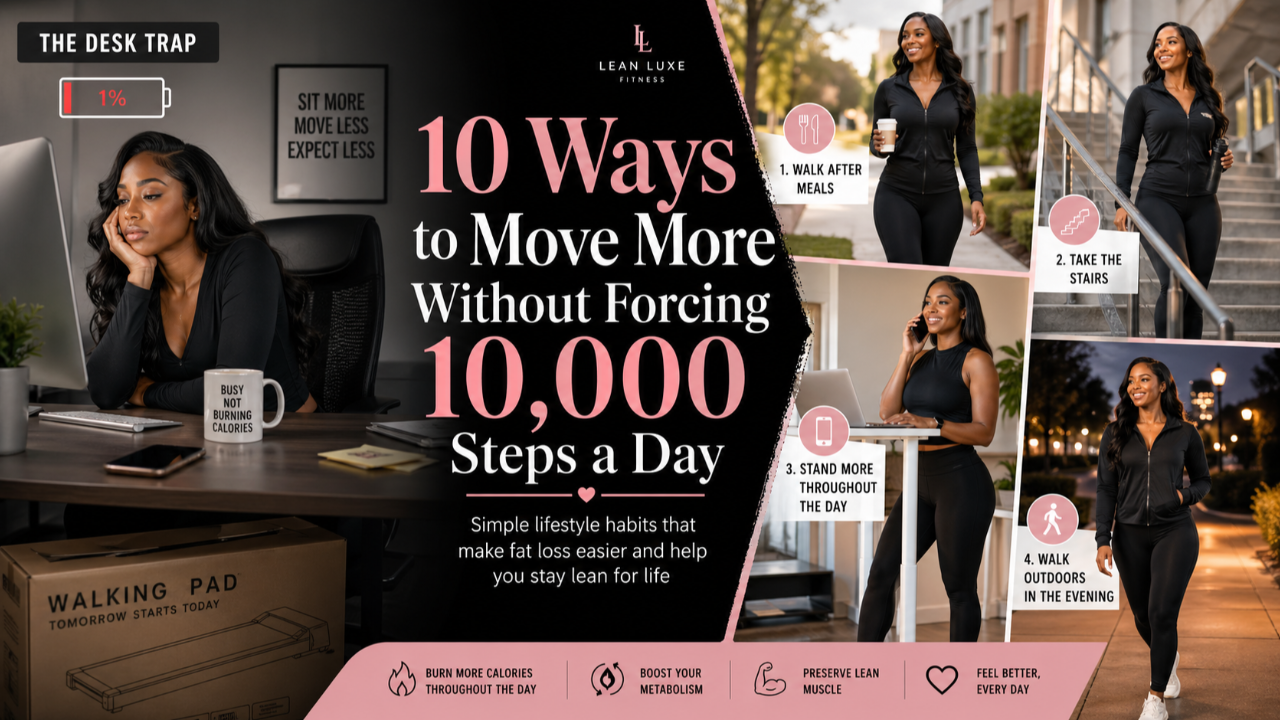
10 Ways to Move More Without Forcing 10,000 Steps a Day
Apr 29, 2026Weight gain does not happen randomly.
For many people, weight gain is the result of repeated lifestyle habits: sitting too much, moving too little, eating without structure, sleeping poorly, and living in a way that does not support the body or health they say they want.
This is why simply buying a standing desk, ordering a walking pad, or forcing yourself to hit 10,000 steps can sound great in theory, but still fail in real life.
Because the goal is not to temporarily do more movement.
The goal is to become a person who lives differently.
One of the biggest reasons people struggle to lose weight and keep it off is because they only do things to lose weight.
They walk only because they are dieting.
They track only because they are trying to drop pounds.
They exercise only because they are unhappy with their body.
Then once the urgency fades, the habits disappear, and the weight comes back.
That is the problem.
The goal is to build habits you can apply for life.
The 10 strategies below are not meant to be a short-term challenge. They are simple ways to add more movement into your normal routine so getting lean and staying lean becomes a result of how you choose to live, instead of what you force yourself to do every day.
You do not need to magically become a person who walks 10,000 steps every single day overnight.
The goal is simpler than that.
The goal is to stop sitting for hours at a time, stop relying on one workout to fix an inactive lifestyle, and start building movement into your normal day.
Fat loss becomes harder when movement only exists inside a 30-minute workout. Your body needs regular movement throughout the day, not just one scheduled session followed by 10 hours of sitting.
Use this guide to make movement automatic.
10 Ways to Move More Without Forcing 10,000 Steps a Day
You do not need to magically become a person who walks 10,000 steps every single day overnight.
The goal is simpler than that.
The goal is to stop sitting for hours at a time, stop relying on one workout to fix an inactive lifestyle, and start building movement into your normal day.
Fat loss becomes harder when movement only exists inside a 30 minute workout. Your body needs regular movement throughout the day, not just one scheduled session followed by 10 hours of sitting.
Use this guide to make movement automatic.
1. Use the 5 minute rule after meals
After breakfast, lunch, and dinner, walk for 5 minutes.
That alone gives you 15 minutes of movement per day without needing a long workout, a perfect schedule, or extra motivation. It also helps your body use glucose more efficiently after eating, because your muscles are active instead of sitting still.
How to do it:
-
Walk around your house
-
Walk around the office
-
Walk outside
-
Walk up and down the hallway
-
March in place if you cannot leave the room
The point is not intensity.
The point is movement after eating.
2. Set a movement alarm every hour
If you sit for work, set a timer to move every hour.
You do not need to stop working for 30 minutes. You just need to break the sitting pattern. Two to three minutes of movement every hour can make a huge difference across the day.
What to do when the alarm goes off:
-
Stand up
-
Walk around the room
-
Stretch your hips
-
Do 10 bodyweight squats
-
March in place
-
Walk to refill your water
Do not overthink this.
Your body does not need a motivational speech.
It needs to move.
3. Take every phone call standing or walking
If you do not need to type, do not sit.
Phone calls are one of the easiest ways to add movement into your day because you are already occupied. Instead of sitting through the call, stand up, pace, or walk around.
Use this for:
-
Work calls
-
Client calls
-
Family calls
-
Check ins
-
Voice notes
-
Long conversations
This turns dead time into movement time.
You are not adding another task to your day.
You are changing how you do the task you already had.
4. Create a morning movement minimum
Before you sit down for work, give yourself 5 to 10 minutes of movement.
This sets the tone for the day before your desk takes over. The longer you wait to move, the easier it becomes to stay inactive.
Morning movement options:
-
Walk outside
-
Walk around the house
-
Do light mobility
-
Do bodyweight squats
-
March in place
-
Do step ups
-
Stretch your hips and back
This does not have to be a workout.
It is a signal.
You are telling your body, “We move today.”
5. Use a “walk before screen” rule
Before you watch TV, scroll social media, or sit down to relax at night, walk for 5 to 10 minutes first.
You are not removing downtime.
You are making movement the cost of entry.
This works because a lot of people spend the whole evening sitting after already sitting all day. That is where the problem compounds. You finish work sitting, drive home sitting, eat sitting, then relax sitting.
Use this rule:
-
Before Netflix, walk
-
Before scrolling, walk
-
Before sitting on the couch, walk
-
Before your nightly snack, walk
You do not need to earn rest.
But you do need to stop stacking hours of sitting on top of more sitting.
6. Make the stairs mandatory
If stairs are available and physically safe for you, take them.
Stop waiting on the elevator like you are being transported to the 47th floor when you are only going up one or two levels.
This is one of the easiest ways to add more movement into your day because it requires no planning, no equipment, and no extra schedule.
Make this the rule:
-
One or two floors, take the stairs
-
If you are not carrying something heavy, take the stairs
-
If your knees and joints can tolerate it, take the stairs
-
If it is reasonable, take the stairs
The point is not to turn every staircase into a workout.
The point is to stop avoiding movement that is already built into your environment.
7. Park farther away on purpose
Stop circling the parking lot for five minutes trying to find the closest spot at work, Walmart, Target, or the grocery store.
You will spend more time hunting for the perfect parking spot than it would take to just park farther away and walk.
Make parking far your default.
Use this rule:
-
Park near the back of the lot
-
Stop waiting for the front row
-
Stop treating the closest spot like you won a prize
-
Park, get out, and walk
This adds automatic steps to your day without needing to “go for a walk.”
You are already going to the store, work, or an appointment.
Use the trip to move more.
8. Do a 10 minute reset walk during lunch
Do not spend your entire lunch break sitting.
Eat, then walk for 10 minutes.
This helps break up the workday, gives your body movement after food, and gives your mind a reset before going back to work.
How to make it simple:
-
Eat your lunch
-
Set a 10 minute timer
-
Walk outside if possible
-
Walk inside if needed
-
Come back and get back to work
This is especially useful for people who sit at a desk all day.
You do not need a full workout at lunch.
You need to stop spending the whole day in the same position.
9. Add movement to household tasks
Your house can either make you more sedentary or help you move more.
A lot of people try to make everything as convenient as possible, then wonder why they barely move. Convenience is nice, but too much convenience removes movement from your life.
Add movement back into normal tasks:
-
Bring groceries in one or two bags at a time
-
Take laundry upstairs in separate trips
-
Walk while tidying up
-
Clean one room at a time
-
Put things away immediately instead of letting them pile up
-
Do a quick 5 minute cleaning reset after meals
This is not about making life harder.
It is about using the tasks you already have to increase daily movement.
10. Build a nightly closing walk
At the end of the day, take a short walk before bed or after dinner.
It does not need to be long. Even 5 to 10 minutes helps you stop ending every day sitting on the couch until bedtime.
Use this as your closing routine:
-
Dinner
-
Short walk
-
Shower
-
Relax
-
Bed
This gives your day a clear finish and helps you stop stacking more sitting on top of an already sedentary day.
The goal is not perfection.
The goal is consistency.
Final reminder
You do not need to force yourself to hit 10,000 steps tomorrow.
You need to interrupt sitting.
That is the real goal.
If your day is currently built around sitting, one workout will not fix the problem. You need a lifestyle that makes movement normal again.
Start with two or three of these habits and make them automatic.
Then add more.
Fat loss gets easier when your daily routine supports the result you say you want.
Ready to do this the right way?
The 21 Day Reset
The 21 Day Reset is designed to stop the crash dieting cycle and teach you how to set up fat loss correctly.
Inside the Reset, you will:
-
Learn how to structure your eating
-
Build strength training consistency
-
Create momentum without burnout
-
Lay the foundation for long-term fat loss
This is the best place to start if you want clarity, structure, and early visible results.
Join The Next 21-Day Rest
1 on 1 Coaching
If you want:
-
A personalized fat loss strategy
-
Weekly adjustments based on real data
-
Accountability that prevents self-sabotage
-
Results that actually last
Then, 1-on-1 coaching is the fastest and safest way to lose 20 pounds of body fat and keep it off.
Apply For Coaching
God Bless. Let's Work.
